Archibull Prize Day 3 Judging The quality is so inspiring

Cranebrook High School

IMG_8269

“Ginny” is a cow you want to touch. She is vibrant and draws the viewer in.

Jenny

Once close you realize she is amazingly tactile with a very interesting finish.

“Ginny” asks a lot of questions of the viewer and is a mass of contradictions. She is modern, industrial and abstract in style.

IMG_8240

Yet has many old-fashioned and antique elements.

She shows old cotton industry practices in the images, but also new cotton industry products which are familiar to us all.

IMG_8273

You expect these modern products to be soft and tactile and yet they are stiff and solid.

IMG_8247

The historical images on her sides are subtle and quite monotone in palette and yet “Ginny” vibrates with colour and stands out across a room.

IMG_8243

She tells an interesting story about the cotton industry but has almost no words on her sides.

IMG_8238

Ag teacher Dani Saxon proudly commented that “making the undies spin was my thing!” Very interesting priorities Dani!

IMG_8316

Ag teacher Dani Saxon and the team spent many hours searching in lots of odd spots for the many and varied items old and new that come together to make up “Ginny”

Jamison High School

1 jamison IMG_8344

“Jules” was named after John Feltham Archibald, the founder of one of Australia’s oldest and best known art prizes. Loving all things European, he later changed his name to Jules Francais. Jamison High’s “Jules” gives a subtle nod to the Archibald Prize, which through a play on words became our name!

Jamison High 1 IMG_8319

“Jules” is made up of a collection of jigsaw puzzle pieces imitating the traditional patterning seen on a dairy cow.

Some of these puzzle pieces have words associated with them relating to the dairy industry and to the needs of the industry as it heads into the future.

IMG_8327

Her head and eyes are beautifully painted in a realistic style, while her ears have quirky puzzle patterning.

Caroline Chisholm

1 IMG_8418

“Athena”, named after the school’s female Holstein cow, says everything you could want to say about the dairy industry in Australia. With her puzzle base and upright stand, she takes the form of a trophy – a trophy proclaiming Dairy as the Winner!

2 IMG_8450

The puzzle base, which depicts a stereotypical dairy farm image, opens up to reveal a series of milk myths, which are then busted by dairy industry facts.

2 IMG_8364

Her sides talk about the impact of the carbon tax on the dairy industry, the staggering quantities of cows needed to provide the required amounts of milk, the processes and the biosecurity risks to the industry itself.

1a IMG_8412

4 IMG_8424

3 IMG_8442

Scattered all over are also a series of QR Codes, which then link the viewer to a wealth of further information. Definitely the complete dairy picture!

There was some morning tea to tempt us

IMG_8388

and a quick visit to the textiles room to check out some more talented teens

Winmalee High School

IMG_8475

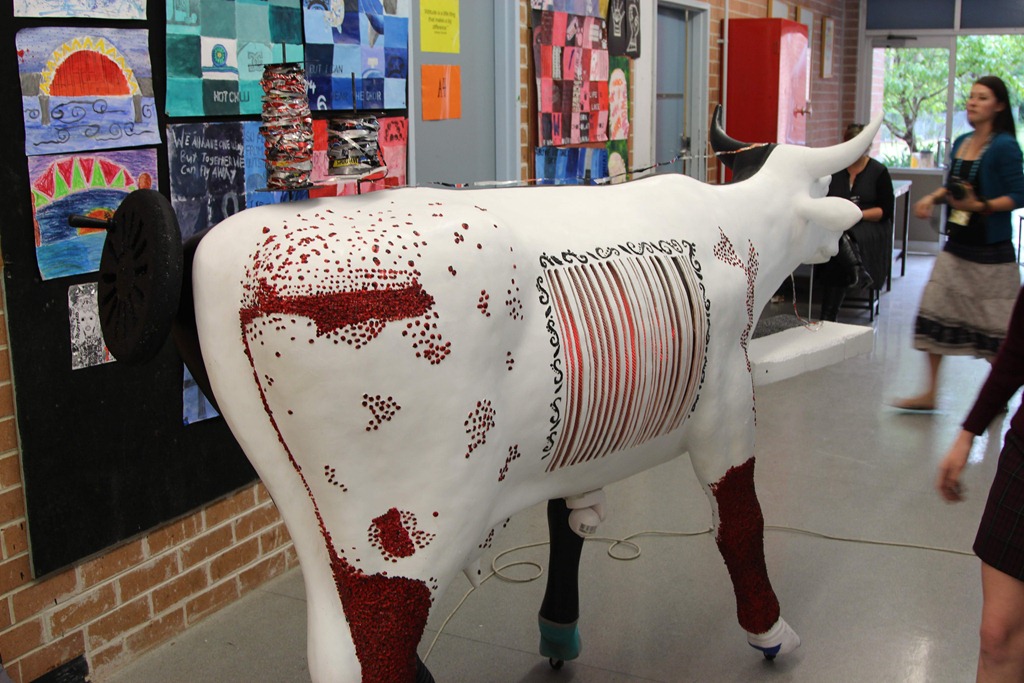
“Singer” shows the yin and the yang of the cotton industry. She challenges preconceived ideas and is very clever.

One side is black. It represents the manufacturing side of the industry. It is a simple, elegant and beautiful depiction of an old-fashioned Singer sewing machine. It is intricately detailed in gold and translates surprisingly well to the side of a cow –who would have guessed this was possible!

Yin

To further the concept of the sewing machine, she has been threaded from head to tail with thread, just as a sewing machine would be. Except that in this case, the thread is not thread at all. It has been made from the sustainable re-use of discarded aluminium cans. (Perhaps this would be a little prickly and sharp to wear??)

Cotton Cans

The other side of “Singer”, is white.

Yang

This is the consumer and highly processed side and appears to scan you as you walk by. It is as though you have been bought, scanned and paid for at a shop- the barcode in her side lights up and she beeps when you come close! Great effect!

Bar Code Off and On Bar code scan offBar Code scan on
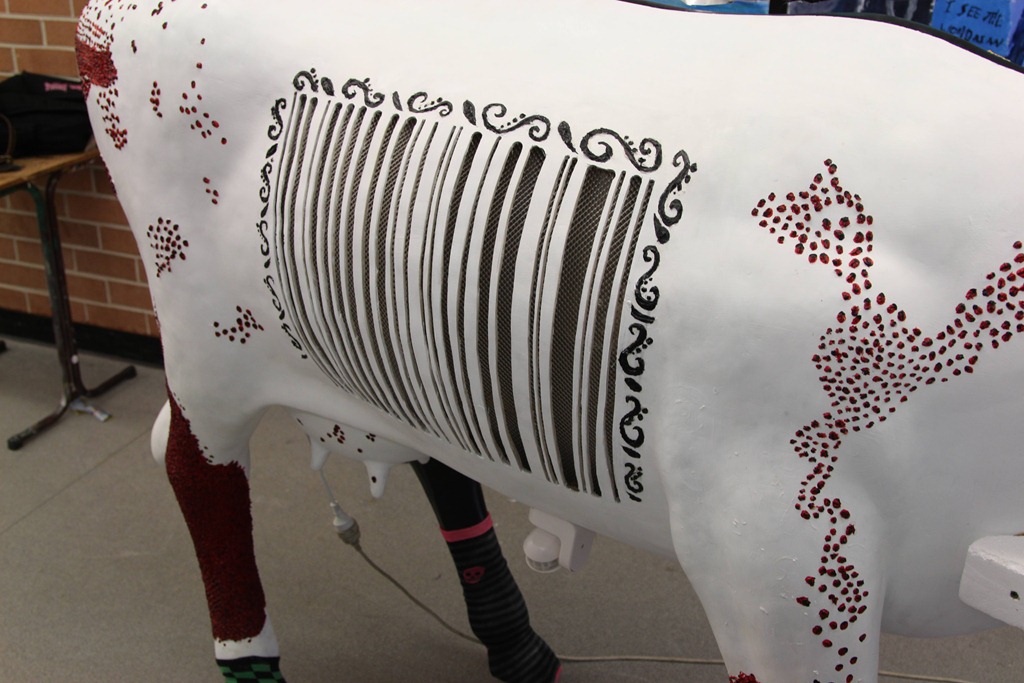
This side also has intricate detailing in the clouds of tiny red ladybirds hovering in areas. They are good for cotton plants as they eat the destructive aphids which are so damaging to the plants. In effect, “Singer” has her own integrated pest management system!

This finishes Day 3 of our Archibull judging! It is definitely time for the weekend and some much needed rest!! We will be ready and raring to go again by Monday morning, I’m sure!

Archibull Prize Judging Day 2…. and more still!

Hills Adventist College

“Missy Moo” has the weight of the wool industry resting on her shoulders. In fact, it is literally built on this poor cow/sheep’s back.

a IMG_8173

The old fashioned stencilling on the bale reinforces this idea even further. “Agriculture Australia” is literally riding on poor Missy Moo.

g IMG_8216

The bale shows some of the history, the processes and the products associated with the wool industry in Australia in soft, subtle sepia tones.

f IMG_8213

Her body itself, while recognisably bovine, has wonderfully tactile fleece patterning, which, while initially distorted, soon morphs cleverly into distinct,  woolly little Australia maps.

g IMG_8214

Hills Adventist College love their Aussie Farmer. Check out their video to see how much

Archibull Prize Judging …a bit more

Model Farms High School

w IMG_8036

“Lady Moo Moo” is a character! (This is not surprising really when you consider her namesake Lady Ga Ga).


She is dressed from head to hoof in denim and cotton, inlaid with intricate and subtle detailing.

y IMG_8080

She is not a cow you are likely to forget easily –not too many cows have horns quite like hers!

v IMG_8027

Her udder and hooves have been carefully and very painstakingly wrapped with precision.

u IMG_8020

and her messages have been, quite literally, sewn into the fabric of her skin.

REMARKABLE FACT

Did you know that Model Farms High School found they had a 100% denim ownership at the school? Every person owned something made from denim –whether it was jeans or some other item.

Archibull Prize Judging Day 2

And we were off and racing into Day 2…

James Ruse Agricultural High School

“Bessie” is a cow of 2 sides- both very individual and very distinctive.

b IMG_8003

On one side she explores the cotton industry through their reliance on water and Australia’s desperate need for this to be done responsibly and sustainably.

a IMG_7999

On her other side she is tactile and has an x-ray effect. The digestive system is mechanical and references the machinery and the science necessary to maintain this industry.

d IMG_7965

Bessie’s two sides are bound together by the cotton plant on her spine. It is wrapped in wire (showing the strength and viability of the cotton plant and the industry itself) and the roots spread out like a cobweb, linking all the parts of the cotton story.


Their video “How to be a Smart Cotton Farmer”  is definitely well worth the watch too!

Even more from day 1

Muirfield High School

‘”T bone” was very definitely a member of the beef industry (and had a name…yay!)

e IMG_7937

A detailed story is told as you move around the cow –from grazing, to processing

c IMG_7958


and then to the end products

d IMG_7931

and meat on the barbie (literally!)

f IMG_7923

Her head has a conversation with farmers through Twitter

a IMG_7914

and AgChatoz

b IMG_7927

while her high-tech collar (with its own satellite) speaks of cutting edge farming practices and the future.

More from Day 1…

Homebush Boys High School

Our next cow also has no name yet… what is it with all of these un-named cows?

a IMG_7837

This is a cow with serious attitude! From its synthetic grass Mohawk, to its Olympic nose-rings and graffiti, this cow is distinctly recognisable as ‘urban’.

d IMG_7861

It is grounded with a very strong sense of the local area and the school community, but if you peek inside its urban shell,

e IMG_7889

there is a definite rural message at its heart,

c IMG_7849

with a subtle nod towards the wool industry.

f IMG_7887

Wendy and the boys ‘discussing’ the cow.

Archibull Prize 2012 judging road trip begins

Over the next two weeks Lynne and artwork judge Wendy Taylor will traverse the state in search of the perfect “Archie”.

Some highlights from Day 1

De La Salle College

This cow whose name remains a mystery at the moment ( but the bright minds are turning over) represents the  cotton industry. A detailed and comprehensive story is told in two opposing ways.

clip_image002

Firstly with a pictorial representation of the industry and secondly through QR codes.

Everywhere you look is QR code sharing a snapshot of the cotton industry .

clip_image004

Once you have played find a code, they allow the viewer to access a series of collected stories in a very simple and effective way. 


They even managed to write their own song. Have a listen its beautiful. Many thanks to Mr Smith 

clip_image006

clip_image008

Now this is fascinating. The cotton bolls we made by paper macheing water bombs to create the boll shape. You can see how to do it here

clip_image010

De La Salle students as is Australia for sale to foreign interests is dearly a concern to these young people

clip_image012

The De La Salle team with teacher Natalie McCaffery 

Remembering our Soldiers

Today’s blog post come from Young Eco Champion Renae Riviere. In her day job Renae is also Regional Manager for the Illawarra and Shoalhaven Conservation Volunteers Australia network

I am confident you will enjoy this very moving account from Renae……..

I’ve never been a “list writer”, but in 2005 I decided to write a list of all of the things I wanted to achieve in my life; the only thing I ever wrote in it was “Be at Gallipoli for ANZAC Day”, then I either got bored with list writing, or totally forgot about the list altogether.

Then on my birthday in 2011, a work colleague called to ask me to be an assistant group leader on the 2012 Conservation Volunteers Gallipoli Volunteer team on ANZAC Day. Best Birthday present ever!!

clip_image002

Both of my grandfathers served in the Second World War and paying respect to our soldiers has always been important to my family. I don’t remember talking much to my Pa and Pop about the war as a kid; maybe I didn’t ask, or maybe they didn’t want to talk about it with us; I don’t really know. I do remember that I loved looking at their medals though.

In 2006 before I went to Japan I sat down with my Pop and looked through his photo albums from when he went to Japan after the bomb was dropped in Hiroshima. He looked so young in the pictures and even though the place looked so sad and demolished, he and his mates still managed to have a laugh, and they looked like they were making the locals laugh too. He said that he would be keen to hear what Hiroshima looked like now, so I told him that I’d bring home some pictures.

I was in Hiroshima on August 6th 2006 for the 61st anniversary of the bomb, but my Pop died 3 days later, so I never got to tell him about it.

clip_image004

A-Bomb Dome in Hiroshima – one of the few buildings left standing after the bomb.

clip_image006

The Children’s Memorial in Hiroshima. Below this is a huge glass room full of paper cranes.

I’ve always had an interest in the First Wold War too. I studied it in year 12 and have always made sure I have been at a dawn service for ANZAC Day and somehow after my 2 grandfathers died, I feel it is even more poignant. Hearing the Last Post gives most people goose bumps; for me it also reminds me of Pop and Pa as it was played at both of their funerals.

For 7 years the organisation I work for; Conservation Volunteers had worked in partnership with the Department of Veterans’ Affairs to take a team of volunteers from Australia and New Zealand to Gallipoli to work at the ANZAC Commemorative Service. The main role of the team is to facilitate a safe and memorable experience for the 6000 or so visitors to the site for the Dawn, Lone Pine and Chunuk Bair services. The Gallipoli Volunteer Team meet and greet people at the gates, hand out info packs and provide a valuable service to the visitors with “special needs” – those who are elderly, ill and/or with mobility issues. This was by far the most rewarding job on the roster; the pace is much slower and you can take the time to have a chat with the visitors as you are assisting them to their special seating area.

In 2012, we took a team of 4 staff and 25 volunteers over to Turkey for ANZAC Day. Our volunteers ranged in age from mid-20’s to mid-60’s and came from a range of different backgrounds; nurses, teachers, retirees and Vietnam Vets, but despite the different backgrounds, everyone bonded really quickly and by the time ANZAC Day came around we were a well-oiled machine.

clip_image008 clip_image010

The veterans in our group stand up and be recognised at the Lone Pine Service and the 2012 leadership team…I’m the short one.

We worked from about 9am on the 24th until the Dawn Service began on the 25th; when we got to stop and actually take in the experience – here we were at ANZAC Cove, watching the sun rise on April 25th! Then it was back to action stations as we assisted the special needs folk up to the Lone Pine Service, which is still very solemn, but somehow a bit more relaxed than the Dawn Service. Then it was back to our hotel for some much needed R and R.

Prior to ANZAC Day we had a week or so to really get to know the Gallipoli Peninsula; we visited cemeteries and battlegrounds, walked the ridgelines our Diggers would have walked and cruised the Agean Sea, allowing us to see the coastline as it would have been seen by the soldiers. All of these experiences were enriched by having both an Australian and a Turkish guide with us, to share both sides of the story.

Having this time to explore the land really blew my mind; I had read about how harsh the conditions were there and about how steep and unforgiving the terrain was, but not until I saw it, and walked it did I truly appreciate it.

clip_image012

 clip_image014

The Sphix and Shrapnel Valley ANZAC Cove from the Agean Sea

We’ve all heard the story of the battle at The Nek and how close the ANZAC and Turkish trenches were, but it really hits home when you stand there on the battle field and realise that it’s about the same size as a basketball court.

Before we left Australia, we were all given the name and some details of a soldier from our home town who died in battle at Gallipoli. Mine was Charles Frederick Roy Fell from Balgownie; just a suburb away from mine. He enlisted on May 15th 1915 and died on August 6th 1915. He was just 23 years old. I visited his headstone at Lone Pine and told the rest of the team about him and about the battle he died in. It made me wonder if any of his family had ever had the opportunity to do the same thing. Yesterday for Remembrance Day I went to my local War Memorial and paid my respects to him again.

clip_image016

clip_image018

Charles Fell’s Head Stone and a volunteer placing a poppy at her soldiers plaque

Whilst staying on the peninsula we also had the opportunity to visit the ancient city of Troy; another thing I would probably write on my list…if I were a list writer. It was really amazing to see an ancient history so different from our own. Then we headed into the hustle and bustle of Istanbul for a few days of mosques, shopping, spices, shoe shines, baklava, traffic and more shopping!!

This was by far the most rewarding travel experience that I have ever had and I would recommend to anyone that does get the opportunity to go to Gallipoli for ANZAC Day, don’t just go for the day. Stop for a few days and take it in; make a connection with the place that it all happened in.

Thanks Renae for sharing this moving experience with us and the Art4agriculture team  are looking forward immensely to working side by side with you in 2013 

Young Farming Champions share agriculture’s story through YouTube

Our Young Farming Champions have been busy over the last 4 months sharing Agriculture’s story using every vehicle available to them.

They have all now created blog posts and YouTube videos (see below) and visited all the schools in NSW participating in the 2012 Archibull Prize.

Cotton Young Farming Champions

Richie Quigley


and Tamsin Quirk


Beef Young Farming Champions

Stephanie Fowler


Bronwyn Roberts


Kylie Stretton


Wool Young Farming Champions

Sammi Townsend


Lauren Crothers

Stephanie Grills

Dairy Young Farming Champions

Tom Pearce


Jess Monteith

Starting and keeping the agricultural conversation going


Today’s post comes from Wool Young Farming Champion Steph Grills who was recently sponsored by Australian Wool Innovation to attend the Young Professionals in Agriculture forum at Sydney University.

Steph Grills on her farm

Steph farms at Armidale in NSW

The aim of the forum was to bring young professionals in agriculture together to connect the dots on issues of our time, including:
– effectively communicating the science of agriculture
– the role of social media in agriculture
– promoting agriculture as a career path
– networking to influence national agendas

The forum acknowledged

The modern face of agriculture will confront many challenges over the coming years. With fewer resources, our young agri-professionals will be faced with the task of leading this sector through a tough period of global food insecurity. In order to reduce the threat of the world slipping into an unprecedented global food crisis, today’s young agri-professionals will need to utilise their skills in an exceptional manner.

A much more efficient and productive group of young agri-professionals requires; coordination, dedication and education. The upcoming “Young Professionals in Agriculture Forum” aims to offer recent agricultural graduates the opportunity to further their professional development through a range of interactive educational workshops. Targeting the areas of communication, education and coordination, it is hoped that this one day conference will leave young graduates feeling invigorated about the challenges that lie ahead and eager to “keep the conversation going”.

Key speakers included our very own Annie Burbrook, Costa Georgiadis from ABC’s Gardening Australia, Social Media expert and Eureka Prize Winner Tony Peacock, Brendan Fox from Farm Plus and Bruce Howie from C-Qual Agritelligence

What follows is Steph’s highlights in her own words …….

It’s exciting to see and even more humbling and rewarding to sit a room full of Young Professionals in Agriculture all from different backgrounds and yet all having a common and united goal, “To start and keep the Agricultural conversation going”.

clip_image002

Costa Georgiadis opened the forum, instilling enthusiasm and such a positive message into the room. Costa has been able to use ABC’s Gardening Australia as a platform to reach those in urban Australia. ‘Agriculture is the kitchen sink of the city’. The work that is being carried out in Bondi by planting herb and vegetable gardens on the curbs of streets to involve communities has demonstrated that its possible in urban areas. He believes in looking at cultural barriers and going around them with vocabulary. Information is just facts which leave a chasm of opportunity. It is the understanding and passion of this information, that is knowledge. You need to use vocabulary in order to engage with people. A perfect example of this is where instead of creating a herb garden, a ‘herb maze’ was created. This engaged people as we are inquisitive by nature, and encouraged people to find out what a ‘herb maze’ entailed as opposed to a simple old garden. Well nothing really. Simply some bark chips for a footpath through the garden in a snail formation. It was the same garden but it attracted and engaged the community.

clip_image004

I have worked extensively with Ann Burbrook through the Young Farming Champions program, and she didn’t fail to impress at the forum. Ann has a way of encouraging those that weren’t apart of the five people in the room of around ninety, that put their hand up because they enjoyed public speaking. Most of us are terrified by the very thought. To speak in public, firstly you need the courage to get up there and then secondly, the confidence to deliver your presentation with passion. It isn’t in fact, about you. It’s about the audience and what you want them to be thinking, feeling and doing. There are many factors in getting your audience to do what you want. This includes your voice, your stance and of course your content. What’s your message?

clip_image006

Tony Peacock, Chief Executive of CRC, introduced the room to the world of Twitter and the merits it provides. We learnt that as followers on twitter, we want posts to be informative, funny and exciting. Not boring and arrogant. No real surprises there however we also learnt that followers like to be challenged and questioned and don’t mind the odd random thought.

We’re also doing a pretty good job of communicating as scientists to other scientists, but we need to think about how to communicate to producers so that it’s valuable to them and then in turn to the community.

Brendan Fox spoke about Building the Knowledge base and how to get value from the internet. There is around 620 million spaces for information, so sorting through the valuable information can sometimes be a challenge.

The Q & A Panel, was the session I found most interesting. Most topics focussed on education, inspiration and engagement for the Agricultural Industry as whole. Some topics covered were that there are many jobs out there, but where are they and how do you find them? Sustainability of agriculture and also branding of the industry and individuals in agriculture was discussed. One major concern was how to involve kids to get a better understanding of the industry at a young age to encourage curiosity as they grow up and leave school. The Young Farming Champions program was a perfect example of how this is beginning to happen. The agricultural sector needs to have more of a voice and to do that we need three key points to market our ideas.

Overall the whole day was incredibly inspirational and informative. I would like to thank the Sydney University and Young Professionals in Agriculture team for getting the whole day up and running and to those guest speakers who donated their time for the day.

I would also like to extend my gratitude to Australian Wool Innovation (AWI) for giving me the opportunity to attend as part of my personal development through the Young Farming Champions Program. I believe these are the types of platforms are such important opportunities for everyone in agriculture and I congratulate AWI for recognising this and supporting their Young Farming Champions to such a high level