The world needs creative, innovative and courageous young people who can connect, collaborate and act. We know that youth may only be 20% of the population but they are 100% of the future. The time is now to let them share their dreams and design the future they want to see.
Art4Agriculuture is feeling very honoured to be featured in Rex Airline OUTthere magazine this month. Special thank you to Mitch Brook the author and the wonderful graphic artist who have both done an amazing job of capturing what we stand for
Look at this imagery- superb
Extra pleased some of our Young Farming Champions are in the spotlight as well. Well done team –
Today’s guest blog post comes from Heather Gow-Carey one of our Eco Champions
But firstly a little bit from me to put it into perspective
One of the things that still fascinates me is despite the vastness of our country just how little of it we can grow food on and how precious our natural resources are to sustain our standard of living now and in the future.
Yes we all know Australia is a pretty big place and what most of us don’t realise (including me until recently) is believe it or not over 60% of it is owned, managed and cared for by Australian farmers. To put this into perspective the white bits on the map below are the 40% of Australia that are classified as non agricultural land.,
What’s even harder to believe is that only 6% of our agricultural land is suitable for growing food. This means our 134,000 farmers have a huge amount of land between them that doesn’t generate an income It therefore goes without saying that Australian farmers are at the frontline of delivering environmental outcomes on behalf of the Australian community and they have a very big unpaid gardening/park keeping gig in any man’s language. I was as flabbergasted as most people when I found out these statistics that overall 94% of what farmers own and manage returns them no direct in your pocket benefit. As one of those farmers of which 50% of our farm is pristine rainforest it does however give great satisfaction and warms your heart to see it support diverse native vegetation and wildlife.
Can you just imagine what its like following the cows home through this – I can tell you its doesn’t get much better
However its very clear as many of our farmers readily admit they don’t have the skillsets nor the time to do all of this gardening alone. Luckily Australia has a whole team of very special professionals called natural resource managers who partner with farmers to help them get the best outcomes for Australia’s scare natural resources.
Last year with support from the Australian Government’s Caring for our Country Initiative Art4Agriculture accessed funding that would allow our Young Farming Champions to train and work side by side and go into schools as part of the Archibull Prize with Young Eco Champions. The outcomes can only be described as phenomenal. Today’s guest blog post comes from Heather Gow-Carey
The Boggabri Blog……………………………..
As part of the Young Eco Champions Program I have developed a strong interest in agriculture and learning more about our industries that feed and clothe us. Even though I grew up in a rural area, I have found my knowledge of agricultural production is quite limited – so I decided that if I wanted to follow a career in natural resource management and agriculture, I really should get some inside knowledge of what is involved on the agricultural side of things.
My first farm visit was cotton!
I was lucky enough to have the help of Sophie Davidson from Cotton Australia in tracking down a working cotton farm that had been improving both their on-farm efficiency and the health of the surrounding environment. She arranged for me to visit John and Robyn Watson who have been farming since 1979 on their farm “Kilmarnock” at Boggabri in Northern NSW.
When John began farming here it was the first cotton to be grown south of Narrabri, along the upper Namoi River.
Both John and Robyn live and breathe cotton. When I first got to the farm, we jumped in the car and started driving around their property. I was amazed! To be honest, I had hardly seen any form of broad-scale cropping before. While John and Robyn have had lots of visitors to their farm, John mentioned that it was very rare to have someone like me who had almost no knowledge of the industry. So at least I didn’t feel too stupid asking the basic questions! I chatted with John about the production of cotton, right from the beginning when they sow the seeds all the way up to harvest – and even about the ginning and export process.
Their property is 1500 hectares plus extra land that they lease from adjoining properties. It is a mixture of cotton, grain and cattle grazing, with about half of it under crop (both irrigated and dry-land). Kilmarnock was one of the first farms to take up the Best Management Practices (BMP) Program and John chaired the Australian Cotton Industry Council’s BMP Committee for three years.
He also played an active role in the implementation of BMP in the Boggabri area, encouraging other local growers to get on board with the program and John and Robyn have been active members of their local Landcare group. Robyn has even written a paper titled Restoring the banks of the Namoi on ‘Kilmarnock’: Success arising from persistence
In 1995, they started a program of improving the riparian areas because they were concerned about bank erosion and pesticide contamination of the river. From this time they have revegetated more than 20kms of riverbank, stretching alongside their property, along with encouraging neighbouring properties to undertake similar work. Robyn has been the driving force behind the Landcare work on their property, she would collect seeds and propagate them in a small nursery that she had set up. In talking to Robyn, she mentioned that there had recently been a few fish surveys undertaken along the Namoi River and there was a sharp increase in both the diversity of species along with the overall counts of fish along the revegetated sections. So not only has their work stopped the erosion of their property and loss of fertile soil, it has improved the environment in a number of ways.
From a farming perspective, the Watsons have been improving the overall efficiency of their production which means they are using less water, pesticides and herbicides and getting higher overall yields. There are a number of ways that they have been doing this:
Having designated dry-land cropping areas, which rely only on rainfall reduces overall water consumption, along with having extensive channel and dam networks to recycle flood irrigated areas. They have also recently got an overhead pivot irrigation system which moves slowing down the crop rows to prevent extra water loss.
All cotton is GM so as to be resistant to round-up and cotton pests. This means that they have reduced the amount of pesticide that is used, so they very rarely have to spray at all. Being resistant to round-up results in reduced soil cultivation and lower amounts of herbicide required on cotton crops to control weeds and facilitates healthier soils through less soil disruption and reductions in residual herbicides.
They ensure that there is always a few ‘refuge crops’ (usually pigeon pea) sown each year, so this allows insects that would be affected by GM cotton to have the ability to persist and not alter their population structure or effect the birds that feed on them.
Robyn is also very talented at spinning cotton, and generously taught me how to do it. I found out firstly you have to pull the bolls away from the cotton plant and pluck out the cotton seeds. This is essentially what happens at the cotton gin, though on a much larger scale. You end up with a bowl full of fluffy cotton balls and from here you can start to spin.
Using an ordinary spinning wheel, it is possible to end up with a range of different thicknesses of hand-spun cotton which can be dyed and then knitted or woven just like wool. I was very impressed and even got to take a few bolls so I could give it a go at home. Robyn is one of the few people who spins with cotton and I think she may be going to go to the Royal Easter Show to do some demonstrations – she is one talented lady!
While I was up north, I was also able to visit the Namoi Catchment Management Authority (CMA) at Narrabri and go out in the field with Lauren Wilson and Megan Davies to conduct some vegetation surveys. One of the target areas that the Namoi CMA is working on is the protection of riparian areas that are not in poor condition, though need some assistance (eg. through fencing out livestock) to ensure that their condition does not worsen. I found this a great experience to have a look at regions that are so climatically different from down on the South Coast of NSW, and find out about the challenges that these regions are facing from an environmental perspective.
‘I really did have a great time visiting Boggabri and Narrabri, even though it was only short, I learnt so much and had such wonderful experiences. Coming into this program, I had the opinion that most people hold about the cotton industry – that it used huge amounts of water and sprayed chemicals all over the place.
From learning from the other Young Farming Champions and this visit to Kilmarnock, I really have changed my perspective of the industry. It is a vital industry to Australian agriculture and is one that is innovative and always changing to promote efficiency and ensure overall productivity.’
‘I now know the story of cotton – it is how this little plant turns into the pair of socks on your feet.’
*Heather has just finished an International Bachelor of Science (Geoscience) (Hons) and gone to Canberra to join the DAFF Graduate program
You can share stories with Heather on Twitter here @HeatherGowCarey
“SOME PEOPLE WANT IT TO HAPPEN, SOME WISH IT TO HAPPEN, OTHERS MAKE IT HAPPEN.”
Last year Art4Agriculuture introduced you to Jordan Kerr a young man who is making things happen. Jordan’s strong social conscience, sense of community and commitment to be the change that needs to happen had already seen him represent Australia at the Global Young Leaders Conference 2011, where he had a speaking gig at the United Nations 2011 in New York.
Having now finished his HSC he is having a gap year before he embarks on a degree in Social Inquiry and International Studies at UTS. With this degree under his belt he will then be looking at a career in international politics and diplomacy. I am confident people like Nick Xenophon would be grateful indeed to have someone of the ilk of Jordan watching their back
Jordan has accomplished a great deal in the last 12 months including represent Australia at the Presidential Inaugural Conference in Washington DC in January 2013.
He has also set up Youth Link Australia (YLA) in 2012 . The aim of YLA is to connect youth across Australia with youth services
I personally see Jordan as a socially conscious leader. I see someone who is aware of the issues facing both local and global communities and is actively trying to correct the problem and providing opportunities to nurture others to do the same.
Today Jordan gives us an update on the last 12 months. I am just not quite sure what to say when I read his story and see what he has achieved in such a short time. I just wonder what I have been doing with my life. If only the world was full of people the calibre of Jordan Kerr
The story so far can be found here and the next chapter follows ……
During the six years I spent at Hurlstone Agricultural High School in Glenfield NSW I was lucky enough to meet a number of fellow students who share my values and priorities and then find a supportive teacher body who encouraged us in our endeavours to find and trial new and different ways to connect with and contribute to the wider community.
Having personally benefited from the many opportunities for Australian youth locally, nationally and internationally, I was keen for other young people to share the benefits as well. So last year six of my fellow Hurlstonians got together and set up Youth Link Australia with the purpose of connecting young people with services and opportunities within their community. By providing a single website Australian youth now have access to a vast variety of resources in one place.
As an organisation we aim to:
Enable youth to easily access national services online in one website.
Encourage youth to get actively involved within their local community.
Provide information in relation to youth volunteering and extra-curricular activities.
Provide information in relation to leadership opportunities locally, nationally and internationally.
We are also very partnership focused and work with other organisations to help promote their work to Australian youth, so if you like what you see when you visit our website we would love to hear from you.
Now to the highlight of my 2013 year so far and that of course is being selected to represent Australia at the Presidential Inaugural Conference which was held in Washington DC during January 2013.
Sponsored by the NSW Government, Xstrata Coal, Dick Smith (the individual not the company) and the John Edmondson VC Memorial Club I participated in the 5 day conference that celebrates the inauguration of the President of the United States.
The conference also explored how President’s run winning campaigns and the roles of Presidential staff. Through practical simulations and hands on seminars we actually got to take on the role of presidential staff and run mock campaigns. The conference also explored the history and the controversy surrounding former US President Richard Nixon. A special screening of the movie All the Presidents Men explored the breaking of the Watergate scandal and can you believe it I later had the opportunity to meet with Bob Woodward one of the United States most acclaimed reporters responsible for revealing the scandal to the public.
Guest speakers at the conference included Dr. Condoleezza Rice, General Wesley Clark and Mr Claes Nobel. Dr. Rice, former U.S. Secretary of State and National Security Advisor to the President spoke about her insider’s perspective of the US Presidency and also about growing up in a segregated community. General Clark, former NATO Supreme Allied Commander, four-star general and Presidential Candidate spoke about his leadership experiences on and off the battlefield. Mr Claes Nobel the grandnephew of Alfred Nobel founder of the Nobel Prize addressed the conference about the importance of youth leadership.
The conference also included an evening performance by The Capitol Steps, a former group of congressional staffers turned songwriters. Along with this a black tie Gala Inaugural Celebration took place at the National Air and Space Museum’s Steven F. Udvar- Hazy Center, home to thousands of aviation and space artefacts, including the Space Shuttle Discovery.
Inauguration day was of course the biggest highlight of the conference. Standing amongst the among the hundreds of thousands of people watching the President take the Oath of Office was a truly unforgettable experience. The national pride and American patriotism was like nothing I had ever seen before.
Jordan was there … he saw history and he was part of it …… I have a feeling he will be making history himself in the not too distant future
This week all our Young Eco Champions and some of our Young Farming Champions came to the farm for another workshop
The superstar attendees
Once again we hired the stunning Glenn Murcutt house on the farm and when the 43 degree heat hit we were certainly able to test out how well he had designed the ventilation. We were pretty impressed Glenn
Wow you don’t see houses like this on your average dairy farm
Victoria Taylor kicked off the weekend with a session for the team on writing scholarship applications and CV’s and job interview techniques. Our YEC’s and YFC all want to be in positions of influence sooner rather than later and we are determined to help them get there.
Heather for example has her eye on Tony Burke’s job and she is off to DAFF to help fast track this. Whilst I don’t think Tony Burke has anything to worry about just yet but a few years down the track I would be surprised if Heather makes her move
Heather (right) being interviewed by Tara
One of the highlights of the weekend was a number of sessions on working in front of the camera
– Camera techniques, skills and spills
– presenter techniques
– interviewee techniques
– unprepared speeches / responses
– writing your own script
– stuff you know – prepared speeches without sounding prepared
We were lucky enough to have our professional videographer Lance on hand to work with NIDA trained director Annie too provide practical applications in front of the camera
Lance checks the lighting
As you know one of the highlights of the Archibull Prize is visiting the schools and meeting the teachers and students. Over the past couple of years we have identified a number of superstar students and we invited two of them to the workshop to interview each of the YFC’s and YEC’s on camera.
Getting up close and personal with the baby calves
Just to you show the talent of the students and one of our team. Tara hams it up with a South Carolina drawl in this interview with Heather who amazingly managed not to crack up. Check it out and remember Tara is only 16 and what’s to be a burns specialist. I don’t know I can see her just maybe taking over from Carrie Bickmore one day
Such talent I so enjoyed my three days with these wonderful young people
As promised here is the full list of winners for the 2012 Archibull Prize
Overall Winning School – Archibull Prize – $1000. This is determined by adding all the points from the 3 elements
Best Cow – $500
Best Blog – $500
Best Project video or PowerPoint – $500
Archibull Prize 2012
The overall winner was James Ruse Agricultural High School at Carlingford closely followed by Tuggerah Lakes Secondary College Berkeley Vale Campus with De La Salle College and Shoalhaven High School tying for 3rd place and just behind them was Model Farms High School. Just 5 points separated 1st and 4th. This was one close competition in every element.
The James Ruse elements that combined to win them the big win
Best Cow was a win for Caroline Chisholm College Glenmore Park with “Athena”
This is what the art judge had to say about “Athena” “ Athena says just about everything that can be said about the dairy industry in Australia. With her puzzle base and upright stand, she takes the form of a trophy – a trophy proclaiming Dairy as the Winner! The puzzle base, which depicts a stereotypical dairy farm image, opens up to reveal a series of milk myths, which are then busted by dairy industry facts.
Her sides talk about the impact of the carbon tax on the dairy industry, the staggering quantities of cows needed to provide the required amounts of milk, the processes and the biosecurity risks to the industry itself. Scattered all over are also a series of QR Codes, which then link the viewer to a wealth of further information. Definitely the complete dairy picture!”
Best blog
The blog component resulted in a tie between De La Salle College at Caringbah and Shoalhaven High School at Nowra
20 schools and lots of excited guests came together today at the home of the Royal Easter Show to find out who had won the Archibull Prize.
There was a lot at stake including these superb hand painted trophies by Wendy Taylor
Muirfield High School was pretty excited to find out they had won the best PowerPoint or Video section
Not only was there a cheque for $500 they got one of those very impressive one off original Archies too
Equally excited was the team from Shoalhaven High School who took out best blog ( a tie with De La Salle College)
Team Shoalhaven with their Young Farming Champion Stephanie Fowler
Team Shoalhaven and their cow
De La Salle College got a big cheque and a trophy
and reconnected with their Young Farming Champion Richie Quigley
Model Farms received an award of excellence for their artwork and their PowerPoint
Model Farms Cow being admired by Young Farming Champion Bronwyn Roberts with Ann Burbrook
This is one visually stunning cow
The winner of the best cow was the team from Caroline Chisholm College seen here admiring their trophy. The dairy industry is sooooo lucky to have these young people telling their story through art . Wow
Congratulations to Winmalee High School who won an Award of Excellence for their very clever cow “Singer” who is featured in the middle of the first photo.
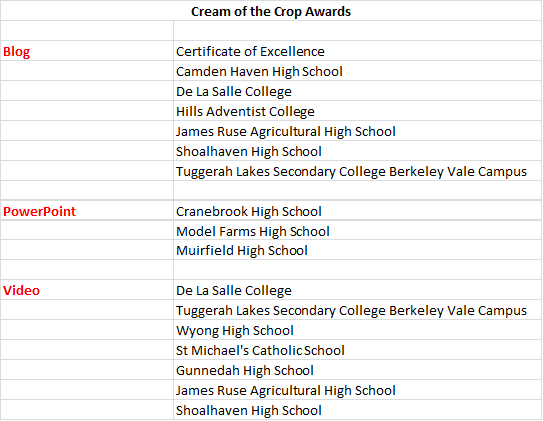
Some of the Cream of the Crop winners
Sarah Leonardi-McGrath with some of the Tuggerah Lakes Secondary College Berkeley Vale Campus team who won a number of Cream of the Crop awards as well as an Award of Excellence for their blog
Sarah had some exciting news for the schools in the audience and I will share this with you shortly
The lovely Sophia Wakeling who we are looking forward to working with in 2013
AND WHO TOOK HOME THE ARCHBULL PRIZE
We did says James Ruse Agricultural High School
James Ruse Agricultural High School students with the Artwork Judge Wendy Taylor and their Young Farming Champion Richie Quigley.
On behalf of Art4agriculture Jordan Kerr says thank you to our Guest of Honour Sara Leonardi-McGrath. More from Sara shortly so watch this space
To our judges – thank you so much this was a tough gig
Alison Fairleigh – over judge
Lisa Claessen – blogs
Ann Burbrook – Videos
Sophie Davidson –PowerPoints
and our very special art judge
Wendy Taylor
I will put a complete list of the Prize Winners on the web in the next few days
Congratulations to all the schools, teachers and students. You did yourselves proud and I salute you all
Thanks to Caring for Our Country funding we will be rolling out the Young Eco Champions program in 2013. As part of their roll the Young Eco Champions will go into schools with Young Farming Champions as part of the Archibull Prize in Southern NSW.
Each Young Eco Champion will also pair with a farmer and work on a Natural Resource Management (NRM) Project together.
Young Eco Champion Megan Rowlatt has already sunk her teeth into hers
Megan starts her journey for you here …….
Not only is Megan a YEC she is also the National Young Landcarer of the Year
Educating landholders about the importance of our native vegetation is one thing, getting them to adopt sustainable management practices and applying this knowledge to the way they use the land is another.
Most landholders and farmers care for the land and the environment. They want the best outcomes for the natural environment as well as the best productivity outcomes for their land. Achieving both can sometimes be a challenge and often the environmental outcomes are secondary to productivity outcomes.
At present, the landholder has attempted to control Lantana and Wild tobacco through slashing and then piling debris within the vegetation, hoping for it to mulch down.
Being involved in the Young Eco Champions (YEC) program, I am able to connect with landholders and other NRM professionals to work towards establishing the best management practices for landholders and their needs on their properties.
By developing practical and realistic plans in consultation with a range of stakeholders, we aim to work towards achieving the best outcomes for the environment as well as the landholder.
Here in the Illawarra, much of our vegetation has become fragmented and is isolated. Clearing activities over time from the early years of the Red Cedar loggers throughout the 1800’s and then for the agricultural industry, high conservation value vegetation such as our Rainforest and Woodland, is now in many areas of our region, restricted to the escarpments and steep foothill areas which were in the past deemed unproductive due to their inaccessibility to farmers, or exists in small isolated patches across the landscape locked up on private property.
Cedar loggers cleared many of the trees in the Illawarra in the early 1800’s
Much of the remnants have become weed infested due to the disturbance and also due to bird drop and wind-blown seed from surrounding weed infested areas.
Our region boasts some of the best prime agricultural real estate in the country and I am really passionate about seeing this industry supported into the future and working together to get the best outcomes for the landscape and these landcarers – because really our farmers are the carers of the largest areas of land, and are the producers of our food for the future.
The dairy industry is now the main agricultural industry and trees are very important for shelter
Fortunately many landholders in our region realise the value in preserving and attempting to rehabilitate natural areas. Benefits to water quality, and shelter for cattle are important issues to farmers, and eliminating threats of noxious, Weeds of National Significance (WoNS) and other environmental weeds from the landscape are also a concern. Sometimes they just sometimes need a little bit of assistance and guidance.
I recently visited my first property I will be working on as a YEC with an experienced Bush Regenerator in prime coastal Dairy country – Jamberoo NSW. Here the rainfall is high, soil fertility is good and the climate is great almost year round. This means perfect conditions for weeds to thrive!
Our project will be looking to rehabilitate two island remnants of rainforest vegetation which sits in open grazing paddock. Although the vegetation is isolated, it is important shelter for cattle, and will also provide refuge for native wildlife travelling through nearby intact rainforest corridors.
At present, the landholder has attempted to control Lantana and Wild tobacco through slashing and then piling debris within the vegetation, hoping for it to mulch down.
Megan and Bush Regenerator Marcus review the site for Megan’s project
Unfortunately this is suppressing any natural regeneration from occurring and opening up the vegetation edges to further weed infestations due to the high level of disturbance. Secondary weeds such as Cape Ivy, Bidens and Mist Flower are also now present and add to the difficulty in managing the vegetation. Although there is a high level of degradation, there is some good stuff in there too!
Our bush regenerator has developed a strategy for rehabilitating the remnants and we will be working in partnership with Landcare Illawarra to source appropriate tubestock for planting projects once the weeds are removed and we can establish where any natural regeneration is occurring. I am excited to be able to have discussions with the landholder and negotiate some control techniques and behavioural changes that will still allow for productive use of the landscape, but not impact on the vegetation and bush regeneration that will be occurring on this site.
Today’s blog post come from Young Eco Champion Renae Riviere. In her day job Renae is also Regional Manager for the Illawarra and Shoalhaven Conservation Volunteers Australia network
I am confident you will enjoy this very moving account from Renae……..
I’ve never been a “list writer”, but in 2005 I decided to write a list of all of the things I wanted to achieve in my life; the only thing I ever wrote in it was “Be at Gallipoli for ANZAC Day”, then I either got bored with list writing, or totally forgot about the list altogether.
Then on my birthday in 2011, a work colleague called to ask me to be an assistant group leader on the 2012 Conservation Volunteers Gallipoli Volunteer team on ANZAC Day. Best Birthday present ever!!
Both of my grandfathers served in the Second World War and paying respect to our soldiers has always been important to my family. I don’t remember talking much to my Pa and Pop about the war as a kid; maybe I didn’t ask, or maybe they didn’t want to talk about it with us; I don’t really know. I do remember that I loved looking at their medals though.
In 2006 before I went to Japan I sat down with my Pop and looked through his photo albums from when he went to Japan after the bomb was dropped in Hiroshima. He looked so young in the pictures and even though the place looked so sad and demolished, he and his mates still managed to have a laugh, and they looked like they were making the locals laugh too. He said that he would be keen to hear what Hiroshima looked like now, so I told him that I’d bring home some pictures.
I was in Hiroshima on August 6th 2006 for the 61st anniversary of the bomb, but my Pop died 3 days later, so I never got to tell him about it.
A-Bomb Dome in Hiroshima – one of the few buildings left standing after the bomb.
The Children’s Memorial in Hiroshima. Below this is a huge glass room full of paper cranes.
I’ve always had an interest in the First Wold War too. I studied it in year 12 and have always made sure I have been at a dawn service for ANZAC Day and somehow after my 2 grandfathers died, I feel it is even more poignant. Hearing the Last Post gives most people goose bumps; for me it also reminds me of Pop and Pa as it was played at both of their funerals.
For 7 years the organisation I work for; Conservation Volunteers had worked in partnership with the Department of Veterans’ Affairs to take a team of volunteers from Australia and New Zealand to Gallipoli to work at the ANZAC Commemorative Service. The main role of the team is to facilitate a safe and memorable experience for the 6000 or so visitors to the site for the Dawn, Lone Pine and Chunuk Bair services. The Gallipoli Volunteer Team meet and greet people at the gates, hand out info packs and provide a valuable service to the visitors with “special needs” – those who are elderly, ill and/or with mobility issues. This was by far the most rewarding job on the roster; the pace is much slower and you can take the time to have a chat with the visitors as you are assisting them to their special seating area.
In 2012, we took a team of 4 staff and 25 volunteers over to Turkey for ANZAC Day. Our volunteers ranged in age from mid-20’s to mid-60’s and came from a range of different backgrounds; nurses, teachers, retirees and Vietnam Vets, but despite the different backgrounds, everyone bonded really quickly and by the time ANZAC Day came around we were a well-oiled machine.
The veterans in our group stand up and be recognised at the Lone Pine Service and the 2012 leadership team…I’m the short one.
We worked from about 9am on the 24th until the Dawn Service began on the 25th; when we got to stop and actually take in the experience – here we were at ANZAC Cove, watching the sun rise on April 25th! Then it was back to action stations as we assisted the special needs folk up to the Lone Pine Service, which is still very solemn, but somehow a bit more relaxed than the Dawn Service. Then it was back to our hotel for some much needed R and R.
Prior to ANZAC Day we had a week or so to really get to know the Gallipoli Peninsula; we visited cemeteries and battlegrounds, walked the ridgelines our Diggers would have walked and cruised the Agean Sea, allowing us to see the coastline as it would have been seen by the soldiers. All of these experiences were enriched by having both an Australian and a Turkish guide with us, to share both sides of the story.
Having this time to explore the land really blew my mind; I had read about how harsh the conditions were there and about how steep and unforgiving the terrain was, but not until I saw it, and walked it did I truly appreciate it.
The Sphix and Shrapnel Valley ANZAC Cove from the Agean Sea
We’ve all heard the story of the battle at The Nek and how close the ANZAC and Turkish trenches were, but it really hits home when you stand there on the battle field and realise that it’s about the same size as a basketball court.
Before we left Australia, we were all given the name and some details of a soldier from our home town who died in battle at Gallipoli. Mine was Charles Frederick Roy Fell from Balgownie; just a suburb away from mine. He enlisted on May 15th 1915 and died on August 6th 1915. He was just 23 years old. I visited his headstone at Lone Pine and told the rest of the team about him and about the battle he died in. It made me wonder if any of his family had ever had the opportunity to do the same thing. Yesterday for Remembrance Day I went to my local War Memorial and paid my respects to him again.
Charles Fell’s Head Stone and a volunteer placing a poppy at her soldiers plaque
Whilst staying on the peninsula we also had the opportunity to visit the ancient city of Troy; another thing I would probably write on my list…if I were a list writer. It was really amazing to see an ancient history so different from our own. Then we headed into the hustle and bustle of Istanbul for a few days of mosques, shopping, spices, shoe shines, baklava, traffic and more shopping!!
This was by far the most rewarding travel experience that I have ever had and I would recommend to anyone that does get the opportunity to go to Gallipoli for ANZAC Day, don’t just go for the day. Stop for a few days and take it in; make a connection with the place that it all happened in.
Thanks Renae for sharing this moving experience with us and the Art4agriculture team are looking forward immensely to working side by side with you in 2013
I recently wrote a post about our Young Farming and Eco Champions workshop at The Crossing in September. This post shares with you more of the wonderful work they are doing and they need your help to make it happen
Jump on board The Crossing’s Big Yellow Taxi project will help to create a song writing camp for young people! The campaign just went live on StartSomeGood! Check it out, share with your friends and contribute if you can so Dean and the team can start some good. BTW they only receive your funds if they meet their goal:
Inspired by songs like Joni Mitchell’s Big Yellow Taxi, The Crossing needs your help to deliver a song writing camp for disadvantaged young Australians. The Big Yellow Taxi Project will inspire remote and isolated youth of the far south coast of NSW, to share and express ideas through music and song, about sustainable and healthy living
Young people from this area often have difficulty engaging in recreational activities and feeling part of the community due to:
a lack of activity options,
a lack of public and private transport
the cost and long distances they have to travel to access extracurricular activities such as professional music training.
Promotional in school sessionsare planned to encourage students from local Secondary Schools to participate in a song writing camp with local professional musicians at The Crossing venue in late December 2012.
To raise funds to pay for musicians and to subsidise camp costs for young people, The Crossing is seeking funds through startsomegood.com Pledge your support by following this link to help them to deliver a song writing camp about ‘what’s good, what’s right and what needs fixing’ and help them build youthful passion and energy in the Australian folk scene
The Young Eco Champions and some of our Young Farming Champions recently travelled to Bega for two days of workshops and one day of in the field experiences.
At each of our workshops we aim to provide insights into the workplace of a farmer from the food or fibre industry the champions represent or a taste of the world of natural resource management
Our Bega workshop in the field experiences led us to The Crossing Land Education Trustwhich is the brainchild of two magnificent human beings Dean and Annette Turner. Dean and Annette gathered an amazing array of local expertise together for us to learn from and work with during our time at The Crossing
Dean and Annette Turner
We are lucky to have our A Team of Ann Burbrook and videographer Tay Plain with us to record the experience for us which we will share with you
Tay Plain sets up for the interviews
Hanging out at The Crossing at Bermagui
Our time at The Crossing which saw the team sleeping in converted railway carriages meant the the YFC’s and YEC’s had the opportunity to follow in Young Eco Champion Heather Gow-Carey’s footsteps as well as see the work National Young Landcarer of the Year Megan Rowlatt is doing to engage young people in Landcare.
Converted railway carriages provide a unique sleeping experience at The Crossing
Megan, Heather and Steph share some weekend highlights with you
Starting with Megan ………………………….
Heading to the far south coast is always a win for me. I absolutely love the landscape and the fact that the coastal communities have been relatively untouched by development. But this trip was even more special. Being amongst such incredibly passionate young farmers and eco champions always leaves me walking away with my head swimming with ideas and feeling inspired to put more energy into what I do for my industry.
Megan leads the team on a tree guild planting exercise
Learning more about the agricultural industry from other young people who are actually actively involved in the industry is fast becoming one of my favourite components of being involved in this program.
See Megan’s interview with Dean Turner here
Heather shares with you some background on quest to save the Koala population on the South Coast……………………….
This year, I have been lucky enough to be able to undertake an Honours project that is both very close to my heart and that will have very real and practical outcomes. Koalas have long been found in the Bega Valley, they were so common that by 1865, the Bega District News reported that it was possible to ‘catch a Koala or Native Bear in the main street of Bega’.
Heather with Chris Allen
The population continued to remain at a high level for the remainder of the nineteenth century, able to support extensive fur trade beginning in the 1890’s, with several million skins being exported from NSW over a 20 year period. The fur trade soon collapsed and it was estimated that koala numbers in the late 1930’s were “only hundreds” throughout NSW. Though the koala populations may have recovered somewhat in the past 80 years, the distribution of koalas on the South Coast has been severely limited due to their vulnerability and inability to adapt to changing habitat conditions.
Learning about koala poo before going out to search a survey point for any evidence of koalas
Going down to The Crossing was a great opportunity to show the other YEC’s and YFC’s the importance of the koala survey work that has been conducted by hundreds of volunteers over the past 4 years. The purpose of the surveys is to try to gauge the current population levels as well as the main areas where they inhabit. From the survey work to date, it is estimated that in the forests to the north-east of Bega, no more than 42 individual koalas remain… and so many people do not realise this!
Chris Allen teaching everyone how to search the base of trees for koala scat
Not only are the surveys quantifying the population, they are educating so many people about the South Coast koalas and the importance of this population. There is the possibility that these koalas are the last remaining truly ‘wild’ koalas, being completely endemic to the region. With such an important and iconic species on the brink of localised extinction, it is great to work alongside people like Chris Allen (OEH) and Dean and Annette Turner (The Crossing) who are so dedicated to the surveys and are always very interested to hear about the progress of my thesis.
It is so rewarding to know that my university work will be able to be used in the field, with the preferred tree species that I have identified, along with the areas of prime habitat that I have mapped being used to assist the survey work along with the revegetation of wildlife corridors. My overall objective is to assess the habitat quality of the region, and my research has raised many interesting questions. It was originally thought that the habitat was marginal or low-quality due to the lack of ‘primary’ feed species and the poor soils and rugged terrain where the population is now limited to, but this might not be the case. It has been thought that these koalas may have a unique ability to forage an existence in this ‘marginal’ country by having unique genes and an inherited knowledge of country and place. Also, other recent research into the nutrient levels of the most utilised trees on the South Coast revealed that they are hardly different to the nutrient levels of many of the primary tree species that koalas are eating in other regions. So the habitat may now not be as poor as originally thought!
Learning about the work The Crossing is doing to create koala friendly wildlife corridors.
I really enjoyed this workshop because it was a chance to share my research with the other young people involved in the YEC and YFC, all the while learning about their industries and lines of work. It really is a two-way learning street and I think that is what I like most about the entire program. It has really made me realise that there is more to agriculture than what I originally thought and it has opened my eyes about how much more there is to learn. The interactions between the farming and natural environments cannot be separate and in order to manage either, it is important to have a knowledge of both. So that is now my goal, to learn as much as I can about whole farm management and best management practices… so I can go off and save the world!
and more thoughts from Megan…….
I think we all took away much more from this workshop than we usually do from each other, and this was all thanks to our wonderful hosts Dean and Annette from The Crossing. Not only did we hear about sustainable design and how we can use resources we already have access to live comfortably, we were able to hear their stories of how they got to where they are today.
Sharing ideas, trials, errors and successes, that’s the key really, in anything we do. Sharing what we learn and then allowing the next generation to come in and build on this, is how we progress and improve. Sharing our stories is the most powerful tool we have in improving our future. It’s just that simple. And spending time with such inspiring people such as Dean and Annette who open their doors to the world to learn from them, just made this resonate with me even more.
Connecting with staff from National Parks and Wildlife Services, environmental educators Dean and Annette from The Crossing, landholders involved in biodiversity projects, and Aboriginal cultural officers all at once really cemented the fact that we are all connected to the land in one way shape or form and we all have a roll and responsibility, but we also have the ability to make a positive change by working together. The South Coast Koala Habitat project is so vital to the survival of this last remaining population of an iconic Australian species on the far south coast of NSW.
So the highlight for me, was taking part in the biodiversity planting and survey work.
Knowing that as volunteers our small efforts were contributing to such a valuable project was rewarding. I always like getting my hands dirty and physically contributing to something worthwhile. And to see so many partners and community members working together to achieve the best possible outcomes for the future of this Koala population is fantastic. And we are now a part of this too.
Some thoughts from meat scientist Dr Steph ………
The best thing about the workshop was that it was hands on. After a short demo on how best to plant the trees for survival and talking about why it was important to do it that particular way, off we went to plant some.
And getting there was lots of fun. Dr Steph in the middle with Heather and Ann ( at the back)
After a chat about the koalas what they face as an impact of habitat fragmentation and how they look for them, off we went to look. Had anyone told me that as a Young Farming Champion I would be looking for koala scats, I am not sure that I would have believed them but the enthusiasm of the group was infectious and we were more than willing to participate.
The infectious enthusiasm of the group drove me to want to participate and learn about everything and Tay’s work behind the camera was no exception.
When Tay needed a hand behind the camera to adjust the lighting, I found myself on the other side of the light and eventually managed to graduate to using the switches on the back. It’s mastering these skills you never think you would ever possibly get a chance at doing that I often find the most rewarding.
From behind the camera, it wasn’t long until I was back in front of the camera interviewing Dean from ‘The Crossing’.
Dean and Annette have a real connection with the land and the environmental education programs, such as the Sea to Snow and the koala surveys, they run there. It was inspiring to have a chance to interview Dean and hear so eloquently, how the landscape around him has altered the journey that he has taken and how that now inspires others.
The significance of ‘The Crossing’ certainly has not been lost and we thrilled to have been part of this experience and to have the opportunity to share it with you .


![Cows on Picasso Laneway Marie Pier 0001_thumb[1]](https://i0.wp.com/champions-4-change.com/wp-content/uploads/2013/03/cows-on-picasso-laneway-marie-pier-0001_thumb1.jpg "Cows on Picasso Laneway Marie Pier 0001_thumb[1]")