Junee spins us a yarn on Day 7 of judging 2013 Archibull Prize

Junee High School and its feeder primary schools – Junee Public School, Ilabo Public School, Eurongilly Public School and Junee North Public School tackled the wool industry for the 2013 Archibull Prize

The 4 primary schools were involved in the painting of the mini Archie “Micron” who is very unique. Never before have we had a little calf that has been such a team effort! Each school was assigned one quarter of Micron and could decorate her in any way they chose.

Junee PS  (56)

Each story is remarkably different, with a different stylistic approach and emphasis, though all are firmly embedded in the wool industry.

Junee North Public School created a vibrant woollen patchwork effect, to take us visually ‘from the catwalks to backyards’, and looks at the multitude of products created from wool. A patch of actual knitted wool, complete with knitting needles, finishes the picture.

Ilabo Public School highlighted the importance and significance of the environment to the wool industry. They also identified some of the features that are critical to sheep and to wool production, including feed and water.

Eurongilly Public School showed us a timeline of wool production – from wool on a sheep, to wool in packs leaving the farm. They feature actual samples of wool and of a wool pack.

Junee Public School created a visual narrative of the wool consumer. Shown through black and white imagery, the consumer is literally surrounded by everything that has been considered when creating and buying a woollen product.

This slideshow requires JavaScript.

Great collaborative effort to all four schools!

School Twenty Eight: Junee High School

“Meria” gives the phrase ‘riding on the sheep’s back’ new meaning!

Junee HS  (7)

The name “Meria” represents all Merino sheep (and other sheep too!), with an ‘A’ for Australia at the end. She tells us all about the wool industry in Australia.

She starts on the farm (as you would expect!) and gives us a pictorial timeline from sheep on the farm, to the shearing shed and its operation (which you can open and peer into), and then to the transportation of wool away from the farm.

Junee  (17)

She then continues the story on her other side, with the processing, the export of wool to the world and the final products. A spinning wheel spins a thread around these stories linking them together.Junee HS  (2)

Riding on her back, under the shade of the tree (that becomes her tail) are a pen (made from shearing combs) of woolly sheep waiting to be shorn. On the knitted patchwork of paddocks underneath, stands the shorn sheep (including the lone black sheep of the family!).

Junee HS  (6)

Her face tells us many of the colloquial sayings which revolve around the wool industry, such as ‘clipped by the shears’ or ‘pulling the wool over my eyes’.

Junee  (60)

This cow definitely knows how ‘to spin a yarn!’

This slideshow requires JavaScript.

On Day 6 Archibull judging we saw and talked a lot of bull

School Twenty Six of the Epic 2013 Archibull Prize judging road trip saw Wendy and Lynne visit Trangie via Dubbo for the first time

Trangie Central School’s “John Bull” is a MACHINE! Lights, sounds and action! He is a very clever cow who can teach you a lot about the cotton picker and its processes. He is the King of the Paddock!”

IMG_0054

John Bull (like his namesake John Deere) is integral to the cotton industry, and focuses in particular on the technical aspects of the industry. He is based on the revolutionary John Deere 7760, which is the most advanced cotton picker available. His paint is even authentic John Deere paint! Very authentic!

He uses actual yellow cotton picker ‘boots’ at the front to pick the cotton and to discard the trash. The circuitry on his sides represents the technology and microchips that help machinery such as this to run. The iPad embedded in his side adds to this and tells even more stories about cotton.

Trangie Central School John Bull (8)

Cotton is caught at the front, picked and sorted as it moves through the cow, to emerge briefly on its way to the catcher where bales are formed. The bales are held, and then dropped at the end of the row.

View album

Movers and Shakers in Cotton

In this case, the cotton bales are very unique and show the process from a mini raw cotton bale, to refined and then to one made from cotton products. This bale also shows logos of local cotton groups and producers, as well as sample pouches of the stages of cotton production and the by-products.

Trangie Central School John Bull (14)

All that is left to tell of the cotton story from Trangie is the postcode of where John Bull was made and where he lives – 2823 written proudly on his side!

This slideshow requires JavaScript.

Day 5 Archibull Prize 2013 Judging Model Farms to Winmalee with a stopover at Jamison and Elizabeth MacArthur High

Continuing on our epic judging day at the Rouse Hill Town Centre library

School Twenty Two was Model Farms High School

Is it a bird? Is it a plane? No, it’s Wool I Am. The super-cow! He has his cape (made from knitted patchwork squares) flying behind him and a knitted mask..

Model Farms  (8)

This is a cow in a form we have never seen before! By breaking the cow into three separate pieces, it allowed them to individually showcase different areas of the wool industry. The initial idea came from the desire to view the cow from multiple angles and to see different elements each time.

Each of the segments tells a story about a different part of the wool industry. The front segment represents ”the farm, the pastures the sheep in their fields” (as well as being filled with balls of wool which represent bales of wool ready for export).

The centre segment represents “the label from a ball of wool and includes some of the important information that encourages us to buy the product”. The interior of this segment depicts the internal organs of a cow.

Model Farms  (32)

The rear segment “reflects the business end of the wool industry, once the wool has left the farm”. Spirals of smoke tell us what the main woollen products are. “The embroidered end describes the processes used on a farm and life from shearing the sheep, wool types and the export of bales”.

A truly inventive cow!

School Twenty Three was Elizabeth Macarthur High School

Eye-popping colour, clean lines and a clear message are all shown by “Apple” at first glance. Her name (which links to a sheep from the schools’ farm) is the most mysterious part of her!

“Apple” shows a whole world of influences as she speaks about the Australian wool industry. She uses simplicity and a series of wrapped woollen images, overlaid on a simplified paddock backdrop with layers of earth below. This backdrop wraps all the way around the cow to give her a beautiful consistency.

Her impeccably wrapped woollen images show, on one side, the world (as we export a large portion of our wool), and on her other side an image of the iconic shearer from the early Australian painting by Tom Roberts called “Shearing the Rams”. The Woolmark and Woolblend logos also feature.

Elizabeth Mac  (18)

“Apple” also references the classic Holeproof TV ads where the farmer puts his sheep in bright red Holeproof socks.

Elizabeth Mac  (16)

The eye-popping red contrasts beautifully with the vibrant woollen and painted images. The red is picked up again in her wrapped horns and tail and in the bunch of apples which hang around her neck like a series of cowbells.

This slideshow requires JavaScript.

School Twenty Four was  Winmalee High School

“Winmeatlee” takes the beef industry from ”farm to plate”, and tells the story of how Australian cattle feed a nation of hungry meat lovers.

With strong stylistic influences drawn from Roy Lichtenstein and Howard Arkley, “Winmeatlee” was always going to be bold and vibrant. She is definitely a modern cow appealing to a modern audience! She references mass media and youth culture.

Winmalee (27)

One side of “Winmeatlee” tells the ‘farm’ story, while the other side tells a ‘suburban’ story. The base links from farm to consumer, though the stories of export, meat cuts and some of the benefits of eating beef. Her feed trough cleverly does not contain food for her, but instead contains food we eat. The meals represented were chosen as the results of a school survey of the most common beef meals.

Winmalee Laura Bunting (4)

Her consistent styling links all components of the story together beautifully and she is sure to catch the eye of anyone passing by!

School Twenty Five: Jamison High School

“Hathor” (which is one of the Egyptian names for their goddess of agriculture) takes us on a journey around the world!

This world trip passes through the main countries which Australia exports beef to, and depicts these countries through an iconic image associated with that country. Amongst these images we see the Statue of Liberty (representing the USA), the Great Wall of China (representing China), Babushka dolls (representing Russia) and camels representing the Middle East.

Jamison HS  (1)

Secondary countries which Australia exports beef to are shown through an image of their flags. Different cattle breeds and butchers shops are also shown.

At her feet, this goddess has a well-travelled suitcase, filled with the essentials for any discerning traveller (of the bovine variety) and becomes her passport to travel the world.

Day 5 of Archibull judging 2013 takes us back to where it all began

Day 5 took us back to the Rouse Hill Town Centre where we had the first launch of the Archibull Prize in 2010

We have 7 schools today so it will be very interesting!

As a taster here are Wendy’s insights into the first 3

School Nineteen was Arndell Anglican College

“Jersey” tells the story of the “threads that bind us together”.

Arndell Anglican College. JPG (6)

She talks about the final products made from much of the cotton industry in Australia –clothes.

Arndell Anglican College. JPG (32)

The story starts with plain white cotton clothing on the washing line. This is a typical Australian image that we can all identify with and immediately recognise. Shown are the basic clothes for all of us – sox, underwear, singlets and t-shirts.

From this image, she then progresses to a bright series of complex geometric patterns which represent some of the retro fashion styles found in 2013.

To emphasize that cotton is the core of the fashion industry, “Jersey’s” internal organs are shown as being made from intertwined cotton plants.

Arndell Anglican College. JPG (25)

The picnic basket on her side shows the different stages of cotton production, as cotton samples in bottles.

School Twenty was Caroline Chisholm College

Having won the Archibull Prize in 2011 and best cow in 2012 with two cows dedicated to telling a very thorough, easy to identify story in an interactive way we were looking forward to seeing what the girls had come up with this year.

It was soon very clear the girls have chosen the same focus this year . There is not much which “Salvador” doesn’t tell us about the cotton industry in Australia, and each part has been shown in an unusual way! He has been designed to appeal to a wide variety of viewers from small children to farmers.

Caroline Chisholm (3)

Salvador is part of a cotton picker!

On the tailgate of the picker, a timeline of cotton growth is shown, both through words and visually through key parts of the cycle forming a pop-up book. These key elements –seed germination, vegetatvie state and then flowering, all lead to Salvador himself who is the mature cotton boll. Harvesting is then shown through the cotton picker (which Salvador is driving).

Caroline Chisholm (22)

The history of cotton and the production cycle are shown on the melting clock faces on either side of Salvador, reminiscent of “melting Clocks” by Dali.

The blocks at the front of the picker, connect to smaller children and tell stories about pests, the products that can be produced from 1 bale of cotton, growing of cotton through the seasons and the importance of Australian cotton.

Caroline Chisholm (4)

The drip irrigation on the udder shows the importance of water to the industry and also how technical the industry has become.

This slideshow requires JavaScript.

Next up was School Twenty One Cranebrook High School

This cow shakes, rattles and rolls!

“HarMoony” is bright and bold and takes a very different approach to the Beef industry in Australia. The approach was to look at the industry through the ways they are trying to harmonise with the environment and with nature.

Cranebrook (19)

They chose to do this through a play on the word ‘harmony’. An interactive approach was taken and a multitude of musical instruments are used.

Here is a little movie I made just to show how clever HarMOOny is

She has chosen the simple and striking colour of bright orange as her base. This is the identifying colour of Harmony Day. The simple black contrast of the words, statistics and musical instruments works well.

She will be a favourite with the kids, but may come home a little worse for all the wear she will certainly get!

Cranebrook (2)

Day 4 of Archibull judging from Northlakes to James Ruse

On Day Four of our Epic Archibull Judging Tour of 2013 found us on the beautiful central coast .

Still predominately following our time schedule, (much to everyone’s surprise -especially us!) and having a great time seeing all these wonderful Archibull cows and meeting the very clever students and teachers who have put their heart and souls into their 2013 Archibull Prize entries over the last 6 months.

School Fifteen was Northlakes High School

Northlakes  (45)

A Starry Starry night, Cornfields (turned into fields of cotton!), a palette of blue and green, and a bandaged head where his left ear used to be. (It is now in a box at his feet, waiting to be sent to his beloved, Rachel.

Northlakes  (78)

He has emerged out of the picture frame at his feet and can only be “Homage to Rachel” and to Vincent van Gogh.

Northlakes Van Gogh Ear (77)

This Archibull is expressive and beautifully painted. It tells a wonderful story about Vincent van Gogh as well as the cotton industry. Growing fields of cotton are shown, as well as the end product (the cotton doilies and cotton bandage). The importance of water to the cotton industry is expressed by the watering can, hovering over the entire scene.

Northlakes  (31)

This “Homage to Rachel” also has a subtle “Where’s Wally” theme going through the use of the Cotton Australia logo. How many can you find?

This slideshow requires JavaScript.

School Sixteen was Tuggerah Lakes Secondary College Berkeley Vale Campus

“Casey Cotton Boll” is very unique (a little bit of an understatement!)

Tuggerah Lakes (85)

She shows three distinct facets of the cotton industry –the planting and harvest of cotton, the manufacture of cotton thread and the transformation of cotton thread into clothing. Each of these facets is shown on a different side of the cow.

That’s right! Three sides to this cow!

No, she is not triangular, but has been split in half lengthwise. This has allowed the school to show each story separately.

One side, through the stylistic influence of Brett Whitely, covers the growth cycle of cotton from seed to harvest. It also shows some of the technology used, the integrated pest management and the importance of water.

Tuggerah Lakes (35)

Her other side tells of the cotton which is exported to be ginned, processed and made into clothing in India and other countries. This has been shown through the delicate motifs of textile patterns and prints of India and Bangladesh, as well as imagery of the Sacred Cow.

Tuggerah Lakes (109)

The inside of Casey is stylistically very different again. She stands on a suitcase, which represents the export of raw cotton overseas, and shows the final product as we commonly see it –clothes. It also links to their Young Farming Champion – Richie Quigley. Tuggerah Lakes (71)

Fabulous work!

This slideshow requires JavaScript.

School Seventeen was Turramurra High School

“Mootilda Purl” does not moo. She bleats like a sheep!

She is, after all, a cow in sheep’s clothing! Her woolly coat is 100% Australian made and will keep her as warm as toast all through winter.

Turramurra  (2)

It showcases the flags of the three main countries that Australia exports wool to –China, India and Italy. She talks about the fact that while Australia exports most of its wool, we also import finished wool products back into Australia.

Turramurra  (47)

She has gorgeous, grassy green knitted legs with bright coloured flowers, seemingly picked up while she was frolicking in a paddock.

Her cowbell motion sensor hangs around her neck, surprising anyone who gets too close.

This slideshow requires JavaScript.

She is quirky and fun and constantly surprises you as she bleats at you. You look around for a sheep, but don’t find a sheep, just a cow in sheep’s clothing!

School Eighteen was James Ruse Agricultural High School

James Ruse is the holder of the 2012 Archibull Prize and it was delightful to see the trophy taking pride of place in their trophy cabinet as we walked through the door

James Ruse  (11)

“Woven” weaves together the story of the wool industry in Australia. She shows the connections between all of the parts to create a cohesive whole.

James Ruse  (71)

She shows the wool industry through its

-history (through the imagery on a film reel),

-connection to Australia (through the colouring and the quirky take on aboriginal motifs),

– people (through a collage of some of the occupations and faces involved),

-technology (through the cog motifs)

-farming (from farm to consumer)

-processes (from greasy to scoured to carbonised and finally to wool top)

She highlights the resilience of the industry as well as between the animal side and the people side of the industry.

This slideshow requires JavaScript.

Whilst a number of schools this year have been inspired by famous artists the James Ruse students said they had been inspired by each other

Day Two of the Epic Archibull Judging Tour of 2013

We were back again to the idyllic setting of the Arts and Crafts Pavilion at Berry Showground for day 2 of judging

We thought we were running on time to start, but we didn’t count on the enthusiasm of the students and teachers with two school arriving before us!

At least we aren’t starting late.

First cab of the rank was Kiama Public School

Pablo ……..has worms!

KIama IMG_8010

Actual, living, breathing worms! (This is a first for us!)

Even better……….the worms have been yarn-bombed!

Now, don’t get too excited! The worms were not individually yarn-bombed (too wiggly I assume), but their worm farm was. It is part of Pablo’s story about Permaculture and sustainable agriculture.

Pablo himself was also yarn-bombed. He shows the digestive processes -from eating grass, to digestion, then manure, and then turning the manure and compost back into grass to start the cycle over again (this is where the worm farm comes in!).

Great story shown in a clever way. Well done! Nice use of worms.

Second cab of the rank was Vincentia Public School and still running on time  –Yay!)

They have name their Archie Booderee which is Aboriginal for Bay of Plenty, and that is exactly what this little cow shows- Plenty!

Vincentia Public School  (10)

She is literally covered from nose to tail in a detailed collage of images drawn by the students. The images depict many of the plants and animals which are significant to aboriginal life in their local area. These have then been interspersed with relevant photos. Strong bands divide the images according to type.

Her head shows images of their local area, while her tail shows images of the amazing ‘bush tucker trail’ created by the school.

In the words of Vincentia Public School:

“Booderee” is like no other calf in Australia. He represents the beautiful area we live in with its wonderful cultural, spiritual and traditional significance of the Aboriginal people.”

Well said!

Day 2 continued ………………………

School Seven was Bega Valley Public School

Buttercup is immediately noticeable.

She is distinct and finely detailed. Her buttercup yellow base (a very appropriately named cow!) is overlaid with striking aboriginal motifs, which form a map of the local area. It shows where the main farming communities are and the paths people take to get to each area, as well as important local mountains and landforms.


In the words of the school:

The Aboriginal design elements make this cow unique. The students involved learnt about their culture as a result of the artistic process. We discussed the unique way that aboriginal artists use symbols to tell stories about their land, and used these to represent the beef and dairy communities in our region.

Her consistent styling makes this a very appealing Archibull.

School Eight was up next and that was Shoalhaven High School

I am not sure that this cow was named correctly, because it is not her udder that is brilliant (though it is not bad in the slightest!) It is her unique stomach that expands your mind! (“Stomach Brilliance” doesn’t quite have the same ring to it though!)


She sends a very detailed message to all about the importance of natural resource management in the dairy industry as well as the increasing use of technology and mechanisation in the industry.

The natural resource base that the industry relies upon for sustainable increases in efficiency is the legs and the living pasture foundation. Her body is about mechanisation and innovation in milking technology and the biomechanical processes of milk production.

But…… back to her brilliant stomach now. Anyone who sees it will definitely remember it. Her side opens up and a material model of an actual sized ruminant digestive system can be pulled out. Details about each of the four stomachs roles are written on it.

It is not slimy or real, but simply “Udderly Brilliant”!

School Nine was St Brigid’s Catholic Primary School

For a fresh take on the beef industry, you really must try the food at Lim’s Cafe! It is the place to be seen.

St Brigids IMG_8313

You see…. there’s this really bright young Archibull called Lim, who has his own little cafe (no long legs allowed!). They serve a wide variety of tasty beef dishes which are all fully explained on the detailed and very informative menu. The decor is bright and colourful with quite a spotted feel to it. The waiters are extremely helpful and informed about the lovely creations of Chef Lim. Even the flooring of this little cafe transports you out into the green countryside!

This slideshow requires JavaScript.

If you are particularly lucky, you may even get the chance to have Chef Lim himself come out and tell you about the wonderful creations he has produced. He really was quite fascinating.

Overall, I felt that Lim’s Cafe provided a lovely dining experience for a judge who needed to ‘Spring into Beef’!

School Ten was Gwynneville Public School

Baa Baa Bovine will be extremely cosy this winter. She has her own teddy and her own paddock and is wearing and amazing jumper.

Gwynneville PS  (1)

Her woolly jumper is made from a wonderful patchwork carefully stitched together (with wool of course!) showcasing the differing types of woollen finishes available. She has been crocheted, knitted, felted, appliquéd, recycled, darned and many more. Her legs have been wrapped, and her hair will keep her head warm all through winter.

This slideshow requires JavaScript.

She is ready for another “Winter Woollies Day” at Gwynneville Public School, (however I think they must have forgotten to check if they got all of the knitting and sewing needles out before she put her jumper on –very uncomfortable!) She wears many labels and tells a wonderful story.

She is literally ‘Wrapped up in Yarn’.

Gwynneville  (1)

Baa Baa Bovine also wrapped up our time in Berry.

Now it was off to Sydney for Day 3

A big ‘thankyou’ to all schools involved in the Berry Exhibition for their wonderful Archies, their clever students and teachers and their enthusiasm.

……

Schools deliver an auditory and visual blast

Yesterday afternoon I attended the most incredible event. The organisation, the style and the superb food  and innovative menu would have done Prince Harry proud

Barrack Heights Public School who are competing in the 2013 Archibull Prize held a launch party to celebrate the finishing of their artwork and the students and teachers involved

IMG_6641

The launch was co-ordinated by Julie Debnam and class teacher extraordinaire Natalie Harris (above) the room was decorated in everything black and white to celebrate  Australia’s most popular breed of the dairy cow – the Holstein

This slideshow requires JavaScript.

Now a COW on a surfboard is not something you see every day, but it’s part of the Barrack Heights Public School Archibull Club’s grand vision for their fibreglass cow, Brocco. I will let the art judge share with you after judging all the very clever elements of the Cow Art

IMG_6489

The 25 students taking part in the Archibull Prize competition this year, decorating their Archie with paint and recyclable materials to showcase their theme, “looking after waterways”.

Their Archie ‘Brocco’ is now covered in colours, a map of Australia’s rivers and indigenous artwork.

Yesterday was a celebration of all things dairy including the menu created by Azarak Experimental Kitchen owner and head chef Shane Debnam

IMG_6589

Those who have dined at Azarak  know we are always about surprises, and for the Archibull, we are surprises abound. We will be charging yoghurt with NO2, churning a milk sorbet with dry ice, smoking milk with hay, steeping milk in straw and souring it to make a soft curd, and wrapping beef in pastoral lucerne, and cooking it sous vide for six hours at 53’c. Like I said; Azarak is always about surprises. says Shane

Shane IMG_6601

Inspiration for the Archibull menu was drawn from the local urban and suburban environment. We will utilise localised foraging to enhance the menu items, paired with our unique brand of approaching ingredients in a scientific, and classical manner.

The best part about using dairy is the versatility of the core ingredient. Dairy encompasses milk, cheeses, yoghurts, sorbets, gelatos, and beef itself. We also want to showcase the local rural and urban environment, with sustainable foraging, pairing it with the best in handmade yoghurts, soft curd and sorbet.

Menu

Our five course degustation auditory and visual sensation

IMG_6587

IMG_6490

IMG_6560

IMG_6613

Cant wait to get permission to show the delight on the students faces to have the opportunity to participate in this experience that saw them create ice-cream through a haze of dry ice

IMG_6627

IMG_6632

Special thanks to Shane and Parmalat for providing the opportunity for all the students to have access to the perfect nutrient cocktail that is dairy

However I must admit the most rewarding part of the experience for me and the wonderful team behind Art4Agricuture was the feedback from the teachers, parents and students.

This is the best experience the school has ever participated in said headmistress Sarah Rudling

Ms Harris said it is great for the students to see a project come together over such a long period of time. “They really love the involvement and seeing it grow.”

Although the students have loved painting their cow, teacher Natalie Harris says they have been most excited when learning about their assigned industry, dairy.

“The kids love it because, one, they get to be involved in a huge art project with a lot of different aspects to it, but also because they’re involved in something they don’t know a lot about,” she says.

“Ninety per cent of it is working on the cow, but 10 per cent is looking at sustainable farming. I think in a way they’ve loved that part more.”

“Not a lot of our kids have been to farms, I think in the group there was about four that had been to a farm.

“For them to able to get some information about the farming industry . . . they have really enjoyed being able to find out where does milk come from, how they look after animals, what a farmer actually does.”

Ms Harris says many parents have told her that their kids have asked them to buy locally-produced milk rather than cartons from the major supermarket brands after their research into the Illawarra dairy industry.

The Archibull Club has also learnt about recycling and the impact rubbish can have on waterways, which Ms Harris says has led to students making a conscious effort to recycle and pick up rubbish at school.

This slideshow requires JavaScript.

They reminded us all the well being of our planet is the responsibility of everyone

THE CHALLENGE WHAT CAN YOU DO

The Challenge – WHAT CAN YOU DO?

Last words from Natalie Harris

That was the most parents that have ever attended a school function.

Thanks again 🙂 I have just loved the whole project

Follow Barrack Heights Public School journey through their blog here

If you would like to check out Azarak Experimental Kitchen on Facebook, please follow the link here.   Don’t forget to like their page!

Water water everywhere. Just who are we kidding

This year we have been able to send Young Eco Champions as well as Young Farming Champions into schools as part of a Department of Agriculture Fisheries and Forestry supported Archibull Prize

This has been particularly rewarding for me as I know just how much our farm has benefited from working with natural resource management professionals and it has given me great joy to be able to partner our Young Farming Champions and the next generation of consumers and decision and policy makers (school students) with these bright young minds.

This slideshow requires JavaScript.

Clover Hill paired with Next Gen to look after the farm’s scarce natural resources

Whereas our Young Farming Champions have their individual food and fibre industries behind them our Young Eco Champions don’t have an umbrella organisation that supports them financially and/or provides them with the type of personal and professional development Art4Agriculture offers and it’s been mind-blowing for me to see how they have flourished under the Young Eco Champions program.

Going into schools the Young Eco Champions have discovered that the knowledge base of students about natural resource management varies widely from school to school from almost nothing to exceptional and seems dependent on the culture within the school with some primary schools in the Archibull Prize 2013 leading the way.

They have found in the main that urban schools have their heads around sustainability in the context of reducing personal carbon footprint through recycling, reduced waste etc. because that’s what is driven through a lot of local council initiatives and some of the students with a rural background understood weed management issues and why it is important to manage weeds however knowledge of what it takes to farm sustainably and wider catchment management issues where almost non-existent.

Last week I joined Young Eco Champion Megan Rowlatt who returned to one of her schools to conduct a bush regeneration workshop with the students.

This slideshow requires JavaScript.

Young Eco Champion Megan Rowlatt and students attacking the evil asparagus fern 

I was recently reminded just how important it is for us all to have a wider knowledge of what is happening to our scarce natural resources beyond our front fences when I came across this article Where the world’s running out of water, in one map by Brad Plumer in the Washington Post

Brad asks the question

And with the global population soaring past 7 billion, this is one of the biggest questions the world is now facing. Can better conservation practices and new technology enable farmers to keep feeding the planet without depleting its most important water resources?

Its pretty scary to know that approximately 1.7 billion people rely on aquifers that are rapidly being depleted and would take thousands of years to refill, according to the study in the journal Nature.

The report, “Water balance of global aquifers revealed by groundwater footprint,” identifies aquifers in the U.S., Mexico, Eastern Europe, the Middle East, India and China as crisis zones where groundwater resources and/or groundwater-dependent ecosystems are under threat because the use of water vastly exceeds the rate at which aquifers are being refilled by rain.

The underground reservoir in north-western India, for instance, would need 54 times more rainfall to replenish the water that’s currently being used by farmers and the local population.

In the map below, the blue areas mark where rain can replenish the amount of water being used by humans. Orange or red areas indicate places where people draw out more for irrigation and drinking water than rain can refill.

The grey areas show the extent of the “groundwater footprint” by representing how much water people are drawing from the aquifers compared with how much water each holds.

Water map

When we know Australia

  • is the driest inhabited continent on earth, with the least amount of water in rivers, the lowest run-off and the smallest area of permanent wetlands of all the continents.
  • and one third of the continent produces almost no run-off at all and Australia’s rainfall and stream-flow are the most variable in the world.

And then you see the big picture problem the world is facing due to an ever increasing scarcity of our precious natural resources its very rewarding to be able to work with and share our Young Farming Champions and our Young Eco Champions and their knowledge diversity and expertise with our school students

Its also very rewarding to be able to provide the schools they visit with the amazing resources our food and  fibre industries are creating to show how farmers are doing their bit and striving to do it better and inspiring the next generation to look beyond their front door and get actively involved as well

Examples of some great industry resources can be found on our web page here

In particular

Target 100 http://www.target100.com.au/Tips-resources

Cotton Australia Education Kit http://cottonaustralia.com.au/uploads/resources/Cotton_Australia_Education_Kit_-_Secondary.pdf

A Wool Growers Guide to Managing Streams and Creeks

http://www.wool.com/Content/en-GB/lww_Rivers_Managing-rivers-creeks-streams.pdf

Red meat and water use. Don’t be fooled by the hype

There are a number of misconceptions in the wider community that sadly are sometimes deliberately promoted by some with an agenda to discredit the livestock industry.

One of those is the red meat industry’s water footprint with outrageous figures often quoted of how much water is required to produce a kilogram of beef

These figures are very flawed because they take in the rain that falls on the pasture

The simple answer to this question is the pasture grows because the rain falls and if the cattle didn’t eat it, the pasture would break down and generate methane anyway. So cattle are a very efficient way of generating food from pasture that would just get wasted.

So let’s look at some background and what is happening on farm (source)

Is water a renewable or non-renewable re source?

The water cycle shows how rain recycles by running off into the sea, then being evaporated to form clouds that will eventually lead to precipitation that can fall on land. Within the cycle, water can be stored as ice, or underground in a water table.

clip_image002

If groundwater is pumped up from a water table, or surface water is taken from a lake, faster than it can be replaced by the natural water cycle, then its use is considered non-renewable.

However, if rainwater can be collected and used before it evaporates, then its use is considered renewable. The more rainwater can be used before it evaporates, the smaller the impact on the water cycle.

There are three main areas to be considered when examining water usage in the cattle and sheep industry:

In the paddock:

Australian cattle and sheep farmers are committed to continually improving their on-farm water efficiency. They do this by taking actions such as creating efficient watering points for livestock (for example, designated troughs for animals to drink from) and maintaining healthy soils and pastures to minimise run-off (and therefore loss of water) during rain.

Water used to raise Australian livestock is generally not diverted water meaning it primarily comes from dams and river systems rather than town water supplies, and cannot be used for other purposes, such as human consumption.

clip_image003

In the feedlot:

Like farms, water use on cattle feedlots primarily relates to water consumption by animals. However, water is also used for feed processing, washing cattle and managing effluent. To reduce water use, the grain-fed beef industry is investing in several initiatives – including reusing water, and minimising water used when processing cattle feed.

In processing:

In beef and lamb processing plants, water is mostly used to ensure food safety and hygiene during operations. The industry is making major investments to improve water efficiency, including reusing and recycling water

Sustainable and efficient use of water is a top priority for our nation, especially in farming – and Australia’s cattle and sheep farmers are leading the way.

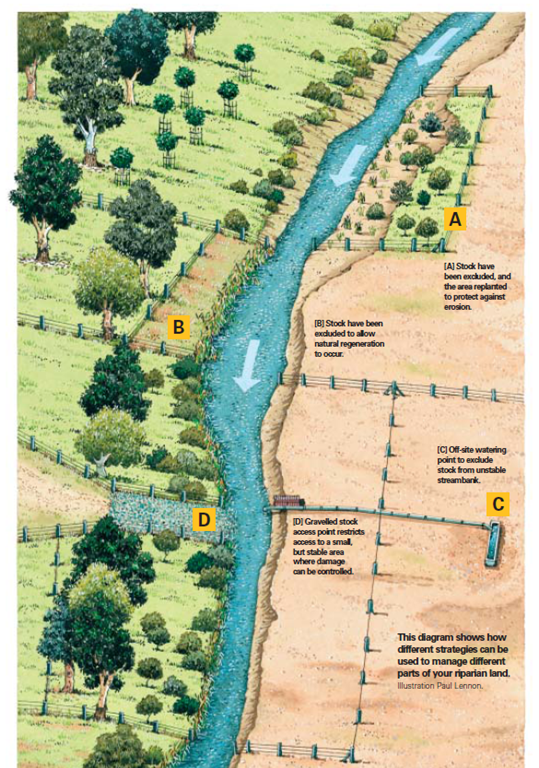
Stock and Waterways (source)

Our waterways and riparian land are valuable asset for farmers and the wider community Riparian areas are often the most productive parts of some farms due to their deeper soils and retained moisture, and may provide good, green feed when other paddocks have dried off.

clip_image004

A riparian zone includes a waterway such as a stream or river and the land immediately either side of the stream. The above picture shows a well manage riparian zone

Unfortunately, they are also at risk of damage, particularly as a result of uncontrolled stock access. This damage can result in the loss of soil, land, stock, and water quality

Studies have shown that removing stock from waterways and riparian areas totally, or for controlled periods, can have a significant improvement on riparian health.

Increased vegetation cover will lead, over time, to a reduction in erosion, better water quality, valuable shelter belts and biodiversity.

This means healthier stock, more efficient use of nutrients and rainfall, and thicker, improved pasture cover and a great result for everyone along the river system.

clip_image006

Farmers install watering points like troughs to water their cattle when cattle no longer have access to the waterways

So lets look at what is happening on farm balance the needs of grazing cattle to produce healthy nutritious affordable red meat and people and the planet

Water efficiency in the paddock

Australia’s unpredictable rain patterns and extended periods of drought mean efficient water management is essential for the community and cattle and sheep farmers. Farmers rely heavily on water-efficient grazing practices to make the most of the water available.

Through grazing management strategies, farmers manage the frequency and intensity of grazing to make the best use of their pastures – balancing the needs of the grazing animal, the pasture and the environment.

As with humans, in on-farm livestock production, the single biggest use of water is for drinking by the animals. Water makes up 60%–70% of the body weight of cattle and sheep, and is essential for maintaining their physiological function.

Water is also an essential resource for establishing and maintaining healthy pastures for Australia’s cattle and sheep to graze.

Water saving initiatives on farm 

Cattle and sheep farmers do many things to influence the water balance in their grazing systems. Healthy soils and adequate nutrients are two of the basic elements of any successful grazing system. Healthy soils drive higher pasture productivity and benefit the environment, through more efficient use of water and nutrients in the paddock, and lower risk of run-off, erosion and deep drainage.

A comprehensive survey of the environmental practices of Australian cattle and sheep farmers in 2010 found that farmers are increasingly monitoring and managing their water use:

  • 55% of farmers had installed additional watering points to replace water for stock from natural watercourses, with 61% of Queensland producers installing water points.
  • 86% of farmers monitored the level of water tables on their properties.

Water saving initiatives in Feedlots

The grain-fed cattle sector employs several strategies to reduce water usage.

These include:

  • Reusing water in cattle wash-down facilities
  • Covering dams to reduce evaporation
  • Restricting water use for feed processing
  • Using neighbouring coal seam gas development water
  • Reusing effluent water for dust suppression
  • The industry is also researching other initiatives, such as treating effluent water


Reducing water consumption in the meat processing industry

Examples of positive strategies being adopted to reduce water consumption at processing facilities include:

  • Using flow meters to monitor water usage
  • Reusing water for cleaning yards and other applications
  • Recovering rich organic compounds and nutrients from treated wastewater and solid wastes, to be transformed into fertilisers and soil conditioners
  • Installing efficient and effective wastewater treatment processes

Water use: the full facts

As I mentioned earlier there are lots of misconceptions about the amount of water used on farms and getting the full picture requires detailed assessment of a wide range of factors.

So measuring the total environmental impact of water consumption – known as ‘water foot printing’ – is far more complicated than simply adding up the volume of water consumed from start to finish.

“You can’t make generalisations, because beef is produced in so many different ways.

“Life-cycle assessment, the scientific discipline, is about trying to look at environmental impacts in a holistic way, to avoid just pushing the problem upstream or downstream in the supply chain,

For example, treating and recycling water might increase energy use, or a water- and energy-intensive farm might be producing more food on a smaller parcel of land, which is important on our increasingly crowded planet. “Arable land is itself a scarce resource.

The answer lies in accurate measurements and successful compromise.

“If we’re going to give anybody any sort of useful information to take pressure off water resources, we need to be a bit more sophisticated than just making simplistic statements about broad product categories, like livestock.” Says Brad Ridoutt from CSIRO Sustainable Ecosystems, Melbourne

Farmers do care about clean waterways and healthy landscapes just like the community.  Just like the community some are doing it better than others. Lets work together to stop the blame and encourage everyone to strive for a healthy planet.

Great resources used here:

Target 100 SUSTAINABILITY STUDY GUIDES Water

NATURAL RESOURCE MANAGEMENT Stock and Waterways

You feed me and I thank you.

There is that old saying that says ‘Nobody on their death bed wished they had made more money’ and everyone would be very happy for somewhere on their gravestone to say ‘Made a Difference’

Each day I find there are more and more young people in agriculture who want to scream from the highest hill that they are proud of being part of the team and that feeds and clothes us

I recently received this email from a very committed young lady who wanted to enrol her city school in the Archibull Prize so they could use their art to share the story about the important role our farmers play

My name is Emma Williams, and I am in my final year at Loreto Kirrbilli.

Emma taking in the sun and scenery at every opportunity

Emma Williams a city girl who values the country and wants to tell its story

As a student living in the city during the term and country during the holidays I see both ‘values’ of my generation.

Essentially, before I leave Loreto (very soon) I would like to set the foundations, or even start a program that allowed girls from the city, who have little opportunity to experience firsthand and understand the value of our farmers that can only come from providing a direct connection between producers and consumers.

Mr Kleeman

Emma received 3rd place in the state wide Brock Rowe Senior Geography Competition for her project ‘To investigate the effects of mining and coal seam gas extraction on Strategic Agricultural Land essential for food production and injurious effects on rural towns and communities in the Liverpool Plains’

This is something I am very passionate about. I am a huge fan of your ‘Archibull’ program – but acknowledge that this year is well and truly underway – however, I feel I must act now if I want to start the journey and build this connection and understanding at Loreto, as I am only one of a few girls with a passion for the agriculture industry.

So basically, I am asking if you had an option, to partake in a ‘mini’ or ‘condensed’ or ‘revised’ Archibull program specifically for Loreto – I completely acknowledge that your resources and time are taken up with the current program that advises numerous schools and I would be willing to find a mentor/industry role model to participate –

I believe the idea of combining the ‘art’ and ‘agriculture’ and the idea of the ‘bull’ is a perfect fit for our extremely creative school.

Again, I completely appreciate your current program is underway and would appreciate if nothing else, your opinion or idea on how to create greater knowledge and mutual understanding and instil more respect in the consumer/ producer relationship.  Emma Williams

As coincidence would have it Emma was introduced to Art4Agriculture and the Archibull Prize after having been sent the link to Young Farming Champion Richie Quigley’s video ‘I grow cotton and you wear it’. Emma being the proactive young lady that she is contacted Richie via the Quigley Farms Facebook page to get his advice on university pathways into agriculture

In her words

‘It is absolutely beyond my wildest dreams to communicate with young farmers (of their nature) and have been so fortunate to be in brief contact with Richie Quigley – not having met him, but being mentored towards the most appropriate university degree for me next year – his input has been invaluable.’

As it turned out the teachers and the students at Loreto where very open to the idea of a ‘late start’ to the Archibull Prize program but in the end felt they could not do it justice in such a short space of time but they have put their names down for next year.

Emma has also built up a huge network of Agvocates on social media and sent congratulatory emails and tweets to many of the people she is seeing who are making a difference to the way people see farmers in Australia and inspiring her to do the same. So I asked Emma to share with me why as a ‘city’ girl she felt this way

Not surprisingly just like another Young Farming Champion Bronwyn Roberts, who is also inspiring next gen, Emma was inspired by her grandfather

This is Emma’s story ………………….

I have an awesome relationship with my grandparents who live on the family property in Tamworth, and I hope to be the 5th generation to farm there. My grandfather is my biggest influence.

Emma Williams and Eric Crowe

Emma with her grandfather Eric Rowe

Every holiday, with my mum and sister we travel to Tamworth, to immerse ourselves for a few weeks in the way of life I like to call ‘home’.

Emma checking the cattle at Sunset

Emma checking the cattle at sunset

To cut a long story short, my grandfather’s prominence in the cattle and stock and station industry, contacts I have made and lifestyle I have for so long desired but only observed have led me to the Agriculture career path I am hoping to embark on next year.

Never being allowed to do hard labour because I am the 'girl'

Never being allowed to do hard labour because I am the ‘girl’

This admittedly hasn’t been easy, and I still choose it ironically with so much desire yet so much doubt.

Most significantly the deterioration of my grandfather’s mental health is underpinning my decision . Still so so so alert, and with a work ethic like no other, his potential in the industry is still exponential, yet there seem so many barriers and red and green tape for him to surmount it has finally beaten him to the ground.

I now see a man, who has no faith in the potential of Agriculture in Australia, and compares the good ‘old days’ to the declining ‘current years’. This no doubt, is incidental, and with my ability to travel up more often next year, and put some youthful input into the business I hope I will be able to breathe some life back into this once proud man.

Perhaps the reality of the past few years in the industry Australia wide has created my biggest doubt. Living in the city where so few value their farmers and would have no idea where the clothes on their back came from and think that life lessons come in the form of wealth makes it difficult to stay passionate.

The demise of the Live Export industry, effects of the drought, and Government notion ‘out of sight out of mind’ have really affected me, not to mention my school work, no time for it. The more I read the more I cannot understand the lack of empathy and massive disconnect between the people who produce the food and the people who enjoy it

I have tried to educate myself on the issues, so that I can share the realities of what I have learnt with others, but to be honest they have no concept that anything beyond the city surrounds impacts on them, and if $1 milk means less expensive, then stuff the farmers.

It really is hard to comprehend the misinformation, and scare tactics that are being fed to cities like Sydney. I am in constant despair at the comments I hear every day and even more concerning is the complete lack of communication on the nightly news about the issues that really impact of on this great country.

Excitingly I am finding through social media networks people are starting to listen, and although people may think their influence is minor, it is those rural advocates’ Facebook pages, blogs, tweets, emails and comments that have opened my eyes to the great opportunity a life in agriculture can offer me. My desire is stronger than ever, to right these wrongs and become involved in an industry that deserves acknowledgment.

I am more than ready to start laying the foundations to the rest of my life, and can’t wait to be an influence on the younger generations, and follow in the footsteps of those forging a new and bright future for young people in agriculture …………

One can never overestimate the power of feedback like this from Emma.  Our Young Farming Champions have a closed Facebook page on which they share the highlights of their YFC journey and they all receive similar feedback to that Emma gave Richie.

Being a part of a successful project team is a very powerful way of encouraging young people and I have watched them all develop invaluable confidence and leadership skills and take other roles of responsibility within their own and the wider community.

On behalf of of the Young Farming Champions and rural agvocates everywhere I thank you Emma for sharing your story