Meet Daniel Fox who is looking forward to balancing the needs of his farm business with the expectations of the community

G’day, my name is Daniel Fox and I am lucky enough to be a fifth generation farmer, my family farming in the Marrar (NSW) district for over eighty years.

clip_image010

Our property of 2000 hectares is located approximately 10 kilometres north of the Marrar township in the heart of “Prime Lamb Country”. Our farm is run by three generations of my family, with my grandad, my father and myself, as well as my grandma, mother, younger sister and girlfriend lending a hand when the times are busy (which seems to be more often than not these days!!!).

clip_image002

All hands on deck: Lamb marking is a family affair.

I have been told that my love of agriculture began at a young age, helping Dad around the farm while still in nappies (although photos show I might have been in the road more often that I helped). As a toddler, when not outside in some sort of machine with dad, I would get out all my farm toys and make each room in the house a different paddock, coaxing mum into pushing all the toys around and around the rooms, spraying, sowing and harvesting them, all in one day! She still blames me for her “crook” knees.

From looking at photos of myself when I was young, I don’t think I stood a chance of being anything other than a farmer. From a young age, I developed an appreciation for all things agriculture, even at shearing time!!!

clip_image004

Learning the ropes from a young age.

As the years passed, I progressed into my schooling career, which began at the local primary school at Marrar with a grand total of around 40 enrolments from around the district. I have some very fond memories of this great little rural school and its enormous (at the time) playground.

clip_image006

View of Marrar silos from home.

When my sister began school, I moved down the road to Coolamon Central School, a K-12 school where I completed my HSC in 2009. As the years progressed, my passion and love for agriculture grew stronger, as did my passion for science and mathematics. Throughout my time at Coolamon the school took great care of my interests in science and maths and accelerated my studies, where I completed my HSC extension mathematics and physics whilst in year 10. Through these years, it was a tough choice to stay inside and pursue my schooling interests rather than help on the farm.

My hard work and tough choices paid off, gaining some great results I am very proud of. As I was going through those last few years of school, the question of “what are you going to do when you leave school” was often asked of me. My response was always the same; I was going to be a farmer. Many people, who were aware of my success in my studies, often did a double take when I told them the I was going to be a farmer. I would get responses like  ‘You should be a doctor or an engineer. You are too smart to be a farmer and you would be wasting your brain if you returned to the farm”.

I was proud to respond that that farming today is a highly complex and challenging  industry that requires the best and the brightest and its the place I want to be. In fact in my opinion it is far more exciting and rewarding than any other ‘prestigious’ occupation that was suggested to me through school.

It was through my later schooling years that I became even more involved in the farm and this fuelled my desire to farm even more. I successfully wrestled the prized “header driver” position from my Dad in my senior years at school, which I’ve always had my eye on since I could walk. When I saw my first good harvest that came after the droughts in the 2000’s that I could appreciably remember in 2010, I felt the great sense of achievement that farming can bring.

clip_image008

Mum, driving the tractor and chaser bin, loves her new toys as much as we love ours!!! Harvest 2013

I began studying a Double Degree in Science and Education at Charles Sturt University. During the four years, I learnt what full time study at university was all about!!! The juggle between study and work on the farm often ended up with me up until all hours of the night in front of the fire trying to catch up with my uni work after coming home from a full day on the farm. All I can say is that I am very glad that those days are behind me!

University was a great chance for me to meet a huge number of new friends, all coming from vastly different backgrounds. My passion for farming was often a topic for conversation, and all too often I found that many of the people at uni had never experienced the joys of agriculture and were often unsure of how we as farmers do things. In actual fact, they had many misconceptions about the workings of a farm that were quite amusing.

During 2012, I also participated in a Rural Leadership Program run by FarmLink Research, a local agriculture research company. All of the participants had a background in agriculture, and whilst talking to them, this topic of common misconceptions about farming and agriculture was a constant source of humour, with some funny ones coming up like the origins of milk being the supermarket shelf .

Farming is our livelihood. We wake up on the farm, walk out the door to the farm, it dominates our conversations with friends and family, and it’s what we love doing. We also know that up to 99% of the population today may not have the generational, educational or experiential understanding of why we do what we do and they are watching every decision we make via the enormous range of multimedia avenues available to them.

So the misconceptions about how food is produced is a topic of concern.   Farmers rely on the support of people disconnected from the origins of their food who work outside our industry to buy what we produce and ensure the decisions that they make with respect to legislation and policy continue to enable farmers to feed and clothe people ethically and profitably.

I am now enjoying a career that allows me to  not only begin to take a greater role in the management of the family farm as well as taking every opportunity to raise awareness about how we farm and why we do it and why we love it.

Meet Anika Molesworth the new Lamb Generation

We need ambitious and innovative people who see past the status quo to embrace sustainable farming now and into the future.

I gives me great pleasure to inform you they are out there. Let me introduce you to our guest blogger Anika Molesworth a young lady with not only a great story to share and the way she tells it you feel like you are walking in her shoes

Anika Molesworth IMG_6910

Intense heat, flies and hours from the closest beach may not be everyone’s idea of a great holiday; however each school break my parents packed the car along with the three children, two dogs and suitcases for all, and headed to Broken Hill. From Melbourne, the drive takes a good 10 hours, factor in some city traffic and breaks for the kids and dogs to stretch their legs, and you’re looking at closer to 13 hours. Believe it or not it takes roughly the same time to travel to Broken Hill from Sydney

Broken Hill

However, the destination is well worth the drive. Broken Hill is centred in a region rich in Aboriginal, mining and pastoral history. The area is closely linked to past explorers such as Captain Charles Sturt, Burke and Wills and William Giles as well as countless Afghan camel trains who opened up Australia’s interior for the benefit of the coming generations.

BrokenHill_main

In far western New South Wales, the conditions are harsh. The average annual rainfall is a mere 259mm, and during summer the temperature can stay above 40oC for days on end. However, it is the rich desert colours which have inspired artists from around the globe, the endless horizons that call to be explored, and the welcoming community living within an iconic outback setting which makes visitors feel at home.

photo

Driving north east from Broken Hill, one will come across Rupee and Clevedale Stations, owned and operated by my family. Incorporating hills of the Barrier Ranges, the properties have a combined size of 10,000 acres.

IMG_7235

The red sand country is vegetated with native grasses, wattles and chenopod scrub, crisscrossed with ephemeral creeks and rocky outcrops. Hand excavated mine shafts tell a story of a bygone era when courageous men went beneath the earth to retrieve silver, lead and zinc.

Grazing our property are our 700 head of Dorper sheep from which we breed our lambs for market.

P1040090

They are a hardy and quick growing sheep that originated from South Africa. The breed is well adapted to survive the semi-arid environment of far western NSW. They have high fertility rates and strong maternal instincts. Along with their high growth rates and potential for domestic and international meat markets, it is no wonder this breed is one of the fastest growing sheep breeds in Australia. Dorpers have a reputation of quality carcass conformation, good fat distribution and great meat flavour. We run our property with sustainability in mind, and operate using organic principles which reflect our commitment to animal welfare and good land governance. We handle our stock using low-stress techniques and use conservative stocking rates to lower their impact on the natural environment.

Upon finishing secondary school I set my sights on the big open skies of outback Queensland. I jillarooed on two prominent Queensland beef properties, both close to 3 million acres, and quickly learnt that farming on such a large scale was no walk in the park. Here you had to work as a team, yet be accountable for your individual actions. There were countless physical and mental challenges that had to be overcome, yet I’d feel a great sense of achievement at the end of a long day of hard work.

P10300421

Education means a lot to me. I strongly believe that one should never stop learning because life never stops teaching. It was this attitude that propelled me through my Bachelor of Science course, specialising in Agribusiness, which I undertook at Charles Sturt University.

IMG_5687

It also encouraged me to re-open the text books and don my thinking cap once again as I embarked on my Masters of Sustainable Agriculture. This tertiary education has been priceless in helping me to understand agriculture as a living and connected system, one that constantly changes and evolves. My particular area of interest is the role which weather plays in influencing farming operations now and into the future. Farmers have always worked around Australia’s dynamic weather patterns, and have learnt to be both adaptive and resilient. However, as the climate becomes increasingly variable, business as usual may no longer be an option, and the sustainability of farming enterprises requires a better understanding of future weather patterns and embracing adaptation and mitigation strategies. At a specific level, I have focused on sheep grazing practices and natural resource management in a climate-constrained world.

IMG_5144

Working with Suncorp Bank as an agribusiness banker has provided me with an excellent opportunity to learn about a wide range of farming industries. I have greatly benefited from their Agribusiness Graduate program, in which I completed three six-month rotations, which saw me working in Tamworth, Orange and Griffith where I am now based. Suncorp has provided me with a supportive environment that actively encourages young professional women to advance within the agribusiness industry.

As you can tell I have a great passion for and strong personal investment in Australia’s sheep meat industry, and hope to inspire others to embrace the diverse and rewarding opportunities that this industry has to offer. We need ambitious and innovative people who see past the status quo to embrace sustainable farming now and into the future.

Lamb Generation

And in the spirit of Australia Day and sharing knowledge, here’s a great lamb recipe that I can’t live without!

Step 1. Preheat a grill pan or barbecue hotplate to medium–high. Rub lamb-leg steaks with olive oil and caramelized onion and season with cracked black pepper.

Step 2. Grill lamb, turning once, for 3–4 minutes either side (for medium), or until lightly charred. Leave to rest for 5 minutes.

Step 3. Meanwhile prepare your favourite salad; mine would be couscous topped with cherry tomatoes, baby spinach, fetta, a sprinkling of mint and a dollop of Greek yoghurt.

Enjoy the mouth watering goodness of this Aussie farmer’s favourite meat!

Delish!

rack-of-lamb-400x265

Schools deliver an auditory and visual blast

Yesterday afternoon I attended the most incredible event. The organisation, the style and the superb food  and innovative menu would have done Prince Harry proud

Barrack Heights Public School who are competing in the 2013 Archibull Prize held a launch party to celebrate the finishing of their artwork and the students and teachers involved

IMG_6641

The launch was co-ordinated by Julie Debnam and class teacher extraordinaire Natalie Harris (above) the room was decorated in everything black and white to celebrate  Australia’s most popular breed of the dairy cow – the Holstein

This slideshow requires JavaScript.

Now a COW on a surfboard is not something you see every day, but it’s part of the Barrack Heights Public School Archibull Club’s grand vision for their fibreglass cow, Brocco. I will let the art judge share with you after judging all the very clever elements of the Cow Art

IMG_6489

The 25 students taking part in the Archibull Prize competition this year, decorating their Archie with paint and recyclable materials to showcase their theme, “looking after waterways”.

Their Archie ‘Brocco’ is now covered in colours, a map of Australia’s rivers and indigenous artwork.

Yesterday was a celebration of all things dairy including the menu created by Azarak Experimental Kitchen owner and head chef Shane Debnam

IMG_6589

Those who have dined at Azarak  know we are always about surprises, and for the Archibull, we are surprises abound. We will be charging yoghurt with NO2, churning a milk sorbet with dry ice, smoking milk with hay, steeping milk in straw and souring it to make a soft curd, and wrapping beef in pastoral lucerne, and cooking it sous vide for six hours at 53’c. Like I said; Azarak is always about surprises. says Shane

Shane IMG_6601

Inspiration for the Archibull menu was drawn from the local urban and suburban environment. We will utilise localised foraging to enhance the menu items, paired with our unique brand of approaching ingredients in a scientific, and classical manner.

The best part about using dairy is the versatility of the core ingredient. Dairy encompasses milk, cheeses, yoghurts, sorbets, gelatos, and beef itself. We also want to showcase the local rural and urban environment, with sustainable foraging, pairing it with the best in handmade yoghurts, soft curd and sorbet.

Menu

Our five course degustation auditory and visual sensation

IMG_6587

IMG_6490

IMG_6560

IMG_6613

Cant wait to get permission to show the delight on the students faces to have the opportunity to participate in this experience that saw them create ice-cream through a haze of dry ice

IMG_6627

IMG_6632

Special thanks to Shane and Parmalat for providing the opportunity for all the students to have access to the perfect nutrient cocktail that is dairy

However I must admit the most rewarding part of the experience for me and the wonderful team behind Art4Agricuture was the feedback from the teachers, parents and students.

This is the best experience the school has ever participated in said headmistress Sarah Rudling

Ms Harris said it is great for the students to see a project come together over such a long period of time. “They really love the involvement and seeing it grow.”

Although the students have loved painting their cow, teacher Natalie Harris says they have been most excited when learning about their assigned industry, dairy.

“The kids love it because, one, they get to be involved in a huge art project with a lot of different aspects to it, but also because they’re involved in something they don’t know a lot about,” she says.

“Ninety per cent of it is working on the cow, but 10 per cent is looking at sustainable farming. I think in a way they’ve loved that part more.”

“Not a lot of our kids have been to farms, I think in the group there was about four that had been to a farm.

“For them to able to get some information about the farming industry . . . they have really enjoyed being able to find out where does milk come from, how they look after animals, what a farmer actually does.”

Ms Harris says many parents have told her that their kids have asked them to buy locally-produced milk rather than cartons from the major supermarket brands after their research into the Illawarra dairy industry.

The Archibull Club has also learnt about recycling and the impact rubbish can have on waterways, which Ms Harris says has led to students making a conscious effort to recycle and pick up rubbish at school.

This slideshow requires JavaScript.

They reminded us all the well being of our planet is the responsibility of everyone

THE CHALLENGE WHAT CAN YOU DO

The Challenge – WHAT CAN YOU DO?

Last words from Natalie Harris

That was the most parents that have ever attended a school function.

Thanks again 🙂 I have just loved the whole project

Follow Barrack Heights Public School journey through their blog here

If you would like to check out Azarak Experimental Kitchen on Facebook, please follow the link here.   Don’t forget to like their page!

You don’t have to be the Candyman to deliver lollipop moments

Take just six minutes out of your day and watch this wonderful TEDxToronto talk from Drew Dudley called “Leading with Lollipops”

Drew asks

How many of you guys have a lollipop moment? A moment where someone said something or did something that you feel fundamentally made your life better?

We need to redefine leadership as being about lollipop moments, how many of them we create, how many of them we acknowledge, how many of them we pay forward, and how many of them we say thank you for. Because we’ve made leadership about changing the world, and there is no world, there are only six billion understandings of it. And if you change one person’s understanding of it, one person’s understanding of what they’re capable of, one person’s understanding of how much people care about them, one person’s understanding of how powerful an agent of change they can be in this world, you’ve changed the whole thing.

Last weekend Art4Agriculture pulled together a team of truly amazing people of the calibre of the gem that is Ann Burbrook and the incredible Gaye Steel  to inspire and support our very talented Young Farming Champions who are all redefining both the word Champion and Leadership.

Every day they are delivering lollipop moments across the landscape in Australia and being the change that agriculture must have

Ann quotes Judy Garland when she gives them this great advice

always be the best version of yourself not a second rate version of some-one else.

We took the opportunity to share the growth of these wonderful young people with their industry sponsors and supporters and held a showcase dinner which the Young Farming Champions hosted themselves.

As a wife and a mother you spend a great deal of time in the background and the stands sharing the blood, sweat and tears of great moments in your family’s life.

On Saturday night the silent tears poured down my face as I watched each of these young people stand up and be the best version of themselves par excellence and so wished all of their parents could have been there sharing this moment with me.

You can see some of the highlights in pictures on Facebook here 

As part of the presentation we saluted some of the highly diverse accolades of the program’s alumni and what was even more enriching was on Saturday we discovered Dairy Young Farming Champion Tom Pearce who tag line has always been

“I am the dairy farmer who puts the cheese on your cracker”

Has now been immortalized by Bega Cheese as the face of the cheese

clip_image001

Then I had the phone call on Sunday from Megan Rowlatt telling me she had been invited to meet Prince Harry today.  That would make 5 of our team mixing with royalty after four of our Wool Young Farming Champions where given the opportunity by Australian Wool Innovation to meet Prince Charles last year

We have Wool Young Farming Champion Sammi Townsend appearing in Dolly Magazine’s up coming  “Inspiring Teens” feature.

Slide35

MLA YFC Bronwyn Roberts won the prestigious 2013 Red Meat Industry Emerging Leader and was the key note speaker at the Marcus Oldham Rural Leadership Program Gala Dinner

Slide31

MLA leveraged the talents of Kylie Schuller and Stephanie Fowler and Bronwyn Roberts at a number of their community events which saw Kylie and Stephanie and Bronwyn mixing with celebrity chefs and Cotton Australia YFC Liz Lobsey was introduced to Queensland Premier Campbell Newman

This slideshow requires JavaScript.

MLA 2012 YFC Stephanie Fowler was invited to present a paper at the 59th International Congress of Meat Science and Technology (ICoMST) 2013 held in Izmir in Turkey

Slide38

Stephanie’s trip to Europe also saw her invited to visit the iconic Max Rubner-Institut which undertakes research in functional foods for a healthy and tasty diet.

AWI YFC Jo Newton and her UNE team won the Enactus Australian Championships. Jo is currently in Cancan, Mexico representing Australia in the World Cup

Slide37

Cotton Australia YFC Richie Quigley seen here receiving his NSW Farmers Scholarship from Barry O’Farrell won first overall and the individual prize in the 2013 Australian Universities Crop Competition (AUCC)

Slide32

This award includes an international ten-day study tour to compete in the Collegiate Crops Contest held in November 2013 in Kansas, USA. Richie’s award includes airfares, accommodation, meals, enterprise visits, and registration to compete in the Collegiate Crops Contest.

The Young Farming Champions instantly came to mind when I read this great article featuring the research of Professor Haslam and his team

An important finding from the team’s research was that in order to get the best out of creative individuals, society needed to invest in the groups that made certain forms of creativity possible. They found that whilst creativity and genius are commonly seen as attributes of an individual, their research indicates the role played by the surrounding group may be just as important.

“Our research supports the argument that geniuses and creative people are very much products of the groups and societies within which they are located.”

“What people create, and how they create it, depends to a large extent on what those around them – those with whom they identify – are doing,”

For the creativity of individual creators to be celebrated, and to make a difference in the world, it has to be enthusiastically embraced by others,”

The argument is corroborated in a number of experimental studies the team has conducted over the past decade which have been published in leading scientific journals. The paper explores how creative individuals are often portrayed as mavericks who, freed from group constraint, can fly in the face of convention.

“Even Steve Jobs needed a group to treat his ideas seriously and to cultivate them,” Professor Haslam said.

“Indeed, it was precisely because people refused to be ‘trapped by the dogma of another person’s thinking’, that Jobs’ idea of the personal computer wasn’t dismissed as lunacy.”

My call to action.

Agriculture identify your young talent, engage them, nurture them and most importantly invest in them and celebrate them

Water water everywhere. Just who are we kidding

This year we have been able to send Young Eco Champions as well as Young Farming Champions into schools as part of a Department of Agriculture Fisheries and Forestry supported Archibull Prize

This has been particularly rewarding for me as I know just how much our farm has benefited from working with natural resource management professionals and it has given me great joy to be able to partner our Young Farming Champions and the next generation of consumers and decision and policy makers (school students) with these bright young minds.

This slideshow requires JavaScript.

Clover Hill paired with Next Gen to look after the farm’s scarce natural resources

Whereas our Young Farming Champions have their individual food and fibre industries behind them our Young Eco Champions don’t have an umbrella organisation that supports them financially and/or provides them with the type of personal and professional development Art4Agriculture offers and it’s been mind-blowing for me to see how they have flourished under the Young Eco Champions program.

Going into schools the Young Eco Champions have discovered that the knowledge base of students about natural resource management varies widely from school to school from almost nothing to exceptional and seems dependent on the culture within the school with some primary schools in the Archibull Prize 2013 leading the way.

They have found in the main that urban schools have their heads around sustainability in the context of reducing personal carbon footprint through recycling, reduced waste etc. because that’s what is driven through a lot of local council initiatives and some of the students with a rural background understood weed management issues and why it is important to manage weeds however knowledge of what it takes to farm sustainably and wider catchment management issues where almost non-existent.

Last week I joined Young Eco Champion Megan Rowlatt who returned to one of her schools to conduct a bush regeneration workshop with the students.

This slideshow requires JavaScript.

Young Eco Champion Megan Rowlatt and students attacking the evil asparagus fern 

I was recently reminded just how important it is for us all to have a wider knowledge of what is happening to our scarce natural resources beyond our front fences when I came across this article Where the world’s running out of water, in one map by Brad Plumer in the Washington Post

Brad asks the question

And with the global population soaring past 7 billion, this is one of the biggest questions the world is now facing. Can better conservation practices and new technology enable farmers to keep feeding the planet without depleting its most important water resources?

Its pretty scary to know that approximately 1.7 billion people rely on aquifers that are rapidly being depleted and would take thousands of years to refill, according to the study in the journal Nature.

The report, “Water balance of global aquifers revealed by groundwater footprint,” identifies aquifers in the U.S., Mexico, Eastern Europe, the Middle East, India and China as crisis zones where groundwater resources and/or groundwater-dependent ecosystems are under threat because the use of water vastly exceeds the rate at which aquifers are being refilled by rain.

The underground reservoir in north-western India, for instance, would need 54 times more rainfall to replenish the water that’s currently being used by farmers and the local population.

In the map below, the blue areas mark where rain can replenish the amount of water being used by humans. Orange or red areas indicate places where people draw out more for irrigation and drinking water than rain can refill.

The grey areas show the extent of the “groundwater footprint” by representing how much water people are drawing from the aquifers compared with how much water each holds.

Water map

When we know Australia

  • is the driest inhabited continent on earth, with the least amount of water in rivers, the lowest run-off and the smallest area of permanent wetlands of all the continents.
  • and one third of the continent produces almost no run-off at all and Australia’s rainfall and stream-flow are the most variable in the world.

And then you see the big picture problem the world is facing due to an ever increasing scarcity of our precious natural resources its very rewarding to be able to work with and share our Young Farming Champions and our Young Eco Champions and their knowledge diversity and expertise with our school students

Its also very rewarding to be able to provide the schools they visit with the amazing resources our food and  fibre industries are creating to show how farmers are doing their bit and striving to do it better and inspiring the next generation to look beyond their front door and get actively involved as well

Examples of some great industry resources can be found on our web page here

In particular

Target 100 http://www.target100.com.au/Tips-resources

Cotton Australia Education Kit http://cottonaustralia.com.au/uploads/resources/Cotton_Australia_Education_Kit_-_Secondary.pdf

A Wool Growers Guide to Managing Streams and Creeks

http://www.wool.com/Content/en-GB/lww_Rivers_Managing-rivers-creeks-streams.pdf

Innovation Innovation wow

This week has delivered some phenomenal stories about productivity increases by Australian farmers with the support of the expertise they outsource

I am blown away by this tribute to our agronomists ( otherwise known as plant and soil doctors)

Agronomists United

Watch it here http://vimeo.com/70913110

Then there is the rise in robotic technology assisting farmers.

Check out this superb example of a drone ( unmanned aerial vehicle) shooting aerial photography

Then there are robots that milk cows


and robots that round up cows

robot_thumb

Robots assisting the horticulture industry. See this great story from Susie Green “embracing Change” 

If you want to put a smile on your face today this is a quirky story about taking the use of drones to a whole new level

Rural vs Urban Challenges in Australia

As part of their Archibull Prize journey the students are asked to do a number of compulsory blogs posts

Today I would like to share with you some of my thoughts on Blog Post 3

This is how we introduce it to the students (and yes we ask the big questions and we look forward to the answers)

Compulsory Blog 3: Rural vs. Urban Challenges in Australia

“Changes to distribution of primary production will have socio-economic implications for individual businesses, industries, towns, schools and regions”

Urban Sprawl

Visit source of map here Note the map is interactive so well worth a look at the article

Outcomes:

Students will be able to understand:

• Competition for land is finely balanced

• Implications for primary, secondary and tertiary industries

• Socio-economic implications

• Impact on biodiversity

And we ask them to do the following when they write their blog

1. Outline the various types of competition for land and the impacts of this competition. Give clear examples and demonstrate that you have made use of the resources provided by referring to what you have learnt.

2. Outline the diversity of competition for the land.

3. What are the social, environmental, economic and cultural impacts as a result of this competition?

4. How may these impacts be overcome?

In the entry survey we asked this question which of course has no right or wrong answer

clip_image002

And this is the answer we got.

Interesting isn’t it interesting the difference between primary and secondary students with close to double our primary school students being very passionate about Natural Parks?.

There is no denying there is a lot of competition for our natural resources and it is imperative we all work together to get the best outcomes

wildlife Corridors

Just connecting up the remnant vegetation to create wildlife corridors is multifaceted – this image can be found on page 2 here

From a farming perspective there is no doubt our farmers face many challenges to put food on the table for Australian families.

Farm amalgamation, declining rural population and services and difficulties in succession planning are changing the structure of the rural community. Farms are getting bigger and the business is becoming more complex and risky. Furthermore, the cost-price squeeze is placing great strain on farmers trying to ensure economic viability whilst trying to address land degradation and environmental issues on their properties.

This great little video looks at some of the challenges

Then there is this great article in The Conversation. The Future of Rural Enterprises in the Global Food Chain

Future sustainability and productivity in the face of climate change, water scarcity and food safety concerns will pose significant challenges.

There are at least four major trends that are likely to impact on rural enterprises in the food sector over the next 40 years:

  1. The mounting pressure on primary producers over food safety and also the need to supply more diverse, wholesome and “authentic” food.
  2. Impact of Climate Change.
  3. The need for rural communities to collaborate for their own self-interest.
  4. Need for enhanced innovation in farming and land use practices as well as waste disposal methods.

Just looking at climate change alone its scary

Impacts on food production

1-62_Page_4

1-62_Page_5

Impacts on biodiversity

Image 1

1-62_Page_3

These images are great but sorry a bit hard to read They are on pages 40 –44 of this

Source http://www.ces.vic.gov.au/__data/assets/pdf_file/0017/152450/1-62.pdf

What is clear is it is going to take a collaborative approach between our urban and rural communities to get the best outcomes. Now here is a nice little community initiative worth applauding JBS Australia and Primo launch Foodbank beef program

Red meat and water use. Don’t be fooled by the hype

There are a number of misconceptions in the wider community that sadly are sometimes deliberately promoted by some with an agenda to discredit the livestock industry.

One of those is the red meat industry’s water footprint with outrageous figures often quoted of how much water is required to produce a kilogram of beef

These figures are very flawed because they take in the rain that falls on the pasture

The simple answer to this question is the pasture grows because the rain falls and if the cattle didn’t eat it, the pasture would break down and generate methane anyway. So cattle are a very efficient way of generating food from pasture that would just get wasted.

So let’s look at some background and what is happening on farm (source)

Is water a renewable or non-renewable re source?

The water cycle shows how rain recycles by running off into the sea, then being evaporated to form clouds that will eventually lead to precipitation that can fall on land. Within the cycle, water can be stored as ice, or underground in a water table.

clip_image002

If groundwater is pumped up from a water table, or surface water is taken from a lake, faster than it can be replaced by the natural water cycle, then its use is considered non-renewable.

However, if rainwater can be collected and used before it evaporates, then its use is considered renewable. The more rainwater can be used before it evaporates, the smaller the impact on the water cycle.

There are three main areas to be considered when examining water usage in the cattle and sheep industry:

In the paddock:

Australian cattle and sheep farmers are committed to continually improving their on-farm water efficiency. They do this by taking actions such as creating efficient watering points for livestock (for example, designated troughs for animals to drink from) and maintaining healthy soils and pastures to minimise run-off (and therefore loss of water) during rain.

Water used to raise Australian livestock is generally not diverted water meaning it primarily comes from dams and river systems rather than town water supplies, and cannot be used for other purposes, such as human consumption.

clip_image003

In the feedlot:

Like farms, water use on cattle feedlots primarily relates to water consumption by animals. However, water is also used for feed processing, washing cattle and managing effluent. To reduce water use, the grain-fed beef industry is investing in several initiatives – including reusing water, and minimising water used when processing cattle feed.

In processing:

In beef and lamb processing plants, water is mostly used to ensure food safety and hygiene during operations. The industry is making major investments to improve water efficiency, including reusing and recycling water

Sustainable and efficient use of water is a top priority for our nation, especially in farming – and Australia’s cattle and sheep farmers are leading the way.

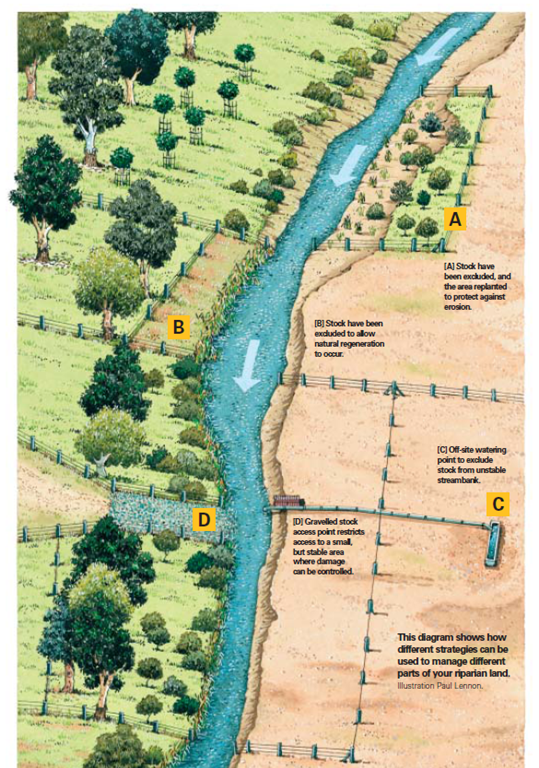
Stock and Waterways (source)

Our waterways and riparian land are valuable asset for farmers and the wider community Riparian areas are often the most productive parts of some farms due to their deeper soils and retained moisture, and may provide good, green feed when other paddocks have dried off.

clip_image004

A riparian zone includes a waterway such as a stream or river and the land immediately either side of the stream. The above picture shows a well manage riparian zone

Unfortunately, they are also at risk of damage, particularly as a result of uncontrolled stock access. This damage can result in the loss of soil, land, stock, and water quality

Studies have shown that removing stock from waterways and riparian areas totally, or for controlled periods, can have a significant improvement on riparian health.

Increased vegetation cover will lead, over time, to a reduction in erosion, better water quality, valuable shelter belts and biodiversity.

This means healthier stock, more efficient use of nutrients and rainfall, and thicker, improved pasture cover and a great result for everyone along the river system.

clip_image006

Farmers install watering points like troughs to water their cattle when cattle no longer have access to the waterways

So lets look at what is happening on farm balance the needs of grazing cattle to produce healthy nutritious affordable red meat and people and the planet

Water efficiency in the paddock

Australia’s unpredictable rain patterns and extended periods of drought mean efficient water management is essential for the community and cattle and sheep farmers. Farmers rely heavily on water-efficient grazing practices to make the most of the water available.

Through grazing management strategies, farmers manage the frequency and intensity of grazing to make the best use of their pastures – balancing the needs of the grazing animal, the pasture and the environment.

As with humans, in on-farm livestock production, the single biggest use of water is for drinking by the animals. Water makes up 60%–70% of the body weight of cattle and sheep, and is essential for maintaining their physiological function.

Water is also an essential resource for establishing and maintaining healthy pastures for Australia’s cattle and sheep to graze.

Water saving initiatives on farm 

Cattle and sheep farmers do many things to influence the water balance in their grazing systems. Healthy soils and adequate nutrients are two of the basic elements of any successful grazing system. Healthy soils drive higher pasture productivity and benefit the environment, through more efficient use of water and nutrients in the paddock, and lower risk of run-off, erosion and deep drainage.

A comprehensive survey of the environmental practices of Australian cattle and sheep farmers in 2010 found that farmers are increasingly monitoring and managing their water use:

  • 55% of farmers had installed additional watering points to replace water for stock from natural watercourses, with 61% of Queensland producers installing water points.
  • 86% of farmers monitored the level of water tables on their properties.

Water saving initiatives in Feedlots

The grain-fed cattle sector employs several strategies to reduce water usage.

These include:

  • Reusing water in cattle wash-down facilities
  • Covering dams to reduce evaporation
  • Restricting water use for feed processing
  • Using neighbouring coal seam gas development water
  • Reusing effluent water for dust suppression
  • The industry is also researching other initiatives, such as treating effluent water


Reducing water consumption in the meat processing industry

Examples of positive strategies being adopted to reduce water consumption at processing facilities include:

  • Using flow meters to monitor water usage
  • Reusing water for cleaning yards and other applications
  • Recovering rich organic compounds and nutrients from treated wastewater and solid wastes, to be transformed into fertilisers and soil conditioners
  • Installing efficient and effective wastewater treatment processes

Water use: the full facts

As I mentioned earlier there are lots of misconceptions about the amount of water used on farms and getting the full picture requires detailed assessment of a wide range of factors.

So measuring the total environmental impact of water consumption – known as ‘water foot printing’ – is far more complicated than simply adding up the volume of water consumed from start to finish.

“You can’t make generalisations, because beef is produced in so many different ways.

“Life-cycle assessment, the scientific discipline, is about trying to look at environmental impacts in a holistic way, to avoid just pushing the problem upstream or downstream in the supply chain,

For example, treating and recycling water might increase energy use, or a water- and energy-intensive farm might be producing more food on a smaller parcel of land, which is important on our increasingly crowded planet. “Arable land is itself a scarce resource.

The answer lies in accurate measurements and successful compromise.

“If we’re going to give anybody any sort of useful information to take pressure off water resources, we need to be a bit more sophisticated than just making simplistic statements about broad product categories, like livestock.” Says Brad Ridoutt from CSIRO Sustainable Ecosystems, Melbourne

Farmers do care about clean waterways and healthy landscapes just like the community.  Just like the community some are doing it better than others. Lets work together to stop the blame and encourage everyone to strive for a healthy planet.

Great resources used here:

Target 100 SUSTAINABILITY STUDY GUIDES Water

NATURAL RESOURCE MANAGEMENT Stock and Waterways

Feeding vs housing the world. No right or wrong choices

In our endeavour to share the great stories of agriculture with as many young people as possible through the Archibull Prize we give as many points in the competition for the multimedia elements as we do for the artwork on the students Archie

One of the key multimedia elements is the blog. In this element the students are asked to produce a weekly web blog which documents the journey of their artwork and their learnings. As part of the program there are a number of compulsory blogs posts.

One of these blogs asks students to reflect on the challenges of feeding, clothing and housing the world and getting the balance right.

This is a big gig and is only going to get bigger in their lifetimes and they have some tough decisions to make. What they will find is there will be no right or wrong choices, just the best choice at that time.

As always we want to know what everyone thinks before they start the program. Lets have a look.

We asked both the primary school students (blue) and the secondary school students (red) what land use they thought was the most important. They had to choose between mining, housing, natural parks and food OR all of them

Which land use is most important

Do you find it fascinating the students think its more important to have more land put aside to look after our native flora and fauna than it is to house people?

But in the main most people thought all of them were equally important. So how do you get a balance and what challenges do our farmers face to feed and clothe people and compete with land for mining, natural parks and housing

Just a few challenges I can think of

  • Growing population – Increasing demand for food
  • Urbanization
  • Globalization
  • Changing patterns of consumption
  • Regulations & market conditions (local / national / international)
  • Limited natural resources land, water, biodiversity, soil, energy
  • Climate change & environmental impact
  • Bio-energy
  • Health & wellness
  • Food safety & emerging pathogens and pests
  • Public acceptance of modern farming practices

Its too big of a wicked problem for me so I am going to defer to some expert opinion I came across recently  in The Conversation

Firstly this article ‘Growing out versus filling in: how about we all grow up?’

A number of issues raised in the article resonated with me

The enduring nature of the debate suggests that we’ve reached a stalemate that is unlikely to be broken by proponents of either side simply shouting louder.

This is not a simple black and white argument, and there are often unacknowledged trade-offs that arise when one stance is pitched against the other.

Food production

Concern about the loss of traditional farmland for urban development has been growing in recent times in Australia. Media and academia alike have warned of a threat to food security as cities rely increasingly on mass-produced agricultural products from distant Australian and international producers. Concern over food miles has led many commentators to call for greater protection of peri-urban agricultural land.

Simultaneously there are calls for the growth of urban agriculture. Food produced within the urban matrix can occur in high density urban contexts, but it’s perhaps most effective in low-density suburban areas where backyards offer ample space. Designing cities to maximise urban agriculture may therefore have the perverse outcome of the expansion of city boundaries into traditional farmland.

Human health and well-being

The recent focus on neighbourhood design and its role in supporting health and well-being has also made its way into the debate about density. For example, low density arrangements usually provide better access to nature through the greater availability of (public and private) green space. Green space is important for exercise and social interaction, while contact with nature more broadly can improve mental well-being and provide psychological restoration.

However, due to their distance from the city centre, low density suburbs can be isolating. They often lack services and involve long commuting times; all of which have negative impacts on health (for example increasing sedentary behaviour). Although high density neighbourhoods can address many of these issues, they also have their own problems: noise and air pollution, traffic congestion, fear of crime and a deficit of green open space. In short, there is no right or wrong answer, since different aspects of health and well-being are accommodated more easily by high and low density urban arrangements.

Biodiversity conservation

As cities expand into the surrounding peri-urban landscape, swathes of native vegetation can been lost. Green open spaces such as parks, reserves, and riparian corridors and gardens are key to promoting biodiversity within cities. Promoting these spaces in urban planning may lead to a larger urban footprint and thus have both positive and negative impacts on biodiversity.

Energy efficiency

Cities with low density housing and high levels of car dependency are criticised for being energy intensive. Arguments are therefore often made for cities to be as compact as possible.

Maximising public transport connectivity and minimising commuting time are important. However, the energy consumed by a city is far more complex than whether it is characterised by high or low density urban form.

The design of suburbs, efficiency of building stocks, use of appliances and technologies, and how the daily lives of citizens are organised also play a significant role. Therefore, increasing density alone does not guarantee improved energy efficiency.

Then there is this thought provoking article The future of rural enterprises in the global food chain of which as few snapshots appear below.

The state of agricultural business in Australia

The Australian Bureau of Statistics (ABS) estimates that there are around 137,447 agricultural businesses operating across Australia. Over the past decade their numbers have decreased by about 3.5% and there has been a decline of around 10% during the same period in the amount of arable land used for farming. For example, in 2001 Australia had some 456 million hectares of land committed to farming, but by 2011 this had fallen to 410 million hectares.

Despite these falls in the number of farms and the amount of land used for farming, the overall productivity of Australia’s farmers has increased substantially. The amount of land used for crops has grown by 31% despite the reduction in overall land used, and the gross value added from agriculture has risen by about 34% since 2001. These trends can be illustrated in the following graph.

Trends in Australian agricultural businesses ABS 2012

This suggests a trend in which the number of farms operating across Australia has shrunk but those that remain have become more productive. These trends are likely to continue well into the future, but there are some serious challenges facing the nation’s farmers that deserve greater attention from our political leaders.

It was part of the discussions that took place on 10 April at a “Food 2050” symposium held in Perth by the UWA Institute of Agriculture. This drew together a cross-section of experts in a range of fields who examined the challenges facing farming communities and the longer term security of our food production system. My task was to address the issue of the state of rural enterprises and this article is based on the speech that I gave there.

The “farm problem”

The problem is caused by the interplay between rising agricultural productivity and the inelastic nature of food demand.

This has led to continual decreases in real farm prices and decreasing returns to farmers. Increasing competition in the food market has meant that any efficiency gains made by producers within their farm businesses are actually captured more by the consumer than the producer.

To counter this trend farm enterprises have sought to expand their area of production, develop new or additional crops or pastures, or grow large via the amalgamation of farms. This has led to the “get big or get out” mindset that has occurred across many of our rural areas in past decades.

However, many farmers lack the financial capacity or the opportunity to expand their business operations. This will result in a few much larger farms and the smaller farms that still exist will generate only minimal income.

Current state of the global food system

To understand the forces that are impacting on our rural enterprises it is important to take a look at the current state of the global food system. Despite farmers experiencing difficulties with farm gate prices the actual price of food rose significantly over recent years. The diagram below shows the Food Price Index of the UN Food and Agriculture Organisation (FAO), which illustrates the trend.

Food Price Index UN Food and Agriculture Organisation (2013)

Another problem is the productivity within agriculture at a global level. Many rural producers around the world are undercapitalised and lack the land or technology to significantly enhance their efficiencies. The food to people ratio of productivity is estimated to need to rise by 70% over the next 40 years if food production is to match supply.

However, there is a lot of wastage. For example, the UN FAO estimates that as much as 1.3 billion tons of food is lost between the field and the table each year due to poor logistics management and storage.

Maintaining sustainability of the food system

There are a number of forces likely to shape the global demand and supply of food over the next 40 years. The first of the factors driving demand is the rising population levels around the world.

By 2050 the world’s population (currently just below 7 billion) will rise to over 9 billion people. China will be expected to see its population peak around 2030, but India’s population will keep growing and the population of Africa is expected to double. For countries across Europe and for Japan the outlook is for population decline.

The rise in population will not only see a demand for more food, but there will be a growing demand for more luxury foods such as meat and dairy, and for foods to be supplied out of season via global supply chains.

The growing population will increasingly live in major cities and there will be a growth in supermarket and fast food retailing operations. In short, people will be wealthier and they will want more processed food, and exotic foods with a change in diets from primarily vegetarian to more meat and protein foods.

The ability for rural producers to meet this rising demand will depend on a range of factors of which one of the most important is the ability of farmers to keep increasing crop yields. Over the past 50 years there has been a dramatic increase in crop yields; however the rate of such increases has slowed each decade.

Our farmers’ capacity to produce more food by 2050 is likely to be dependent on R&D that can result in breakthroughs in technologies and farming practice. This will require the adoption of new animal breeding and husbandry techniques plus new varieties of crops.

Working against this rise in primary production is the impact of climate change and concerns over food safety and ethics. For example, climate change is already impacting on weather patterns generating floods or drought and while scientists continue to debate the nature of this impact, there are already signs of climate change negatively affecting already fragile river systems and associated fish stocks.

In the oceans the supply of fish is also under pressure. There has been a growth in the past 50 years in the world’s fishing fleets and over the past 40 years this fleet has increased sixfold. However, most of the world’s fish stocks are now harvested to full capacity or over exploited and fish harvests are either static or declining.

In many regions there is a decline in soil productivity and the clearing of new farmland is fraught with environmental concerns due to the impact this has on carbon emissions. For example, it is estimated that on average the clearing of land for farming leads to net CO² emissions that are 6 times greater than those generated by other forms of land use.

Overcoming the climate change sceptics

Yet many primary producers are resistant to the challenges of climate change. In a study of Australia’s Farming Future the federal Department of Agriculture, Fisheries and Forestry, surveyed 1,000 farmers in relation to their attitudes towards climate change. They also surveyed 1,000 people from urban areas.

While 58% of the urban population believed climate change was real and caused by human activity, only 26% of primary producers held this view. As illustrated in the following diagram these farmer groups were segmented into different types of sceptic. Some were sceptical but had been hit by drought and therefore were prepared to start taking action. Others were sceptical and had not yet felt any environmental impacts so they felt no need to take action.

Primary producer segments in relation to climate change Donelley, Mercer, Dickson and Wu (2009)

The ‘strugglers’ were not only sceptical but had no resources to apply to any remedial action. Even those who accepted climate change science were of the view that government assistance was required to allow them to take action.

These attitudes amongst rural producers are important as they will determine how readily many farmers adopt more sustainable farming practices, reduce new land clearing and introduce programs such as enhanced biodiversity of cropping, interlocking crop cycles, dense polycultures, biochar and carbon management.

Consumer Confidence

Feeding into this mix will be market based pressures over food safety and the ethical treatment of animals. Consumers are increasingly concerned over use of genetic modification in foods and the safety of foods. The complex nature of food supply chains makes it more likely that accidents will occur.

They also result in government regulators and major food retailing groups imposing more stringent food safety codes of practice. These factors impact on rural producers by forcing up the cost of food production and supply.

Supply chain funnel in the agrifood sector

One of the problems facing agricultural producers is the “supply chain funnel” that has emerged in the agrifood sector. As shown in the diagram below there is a “choke point” in the area of buying desks that are increasingly no longer in farmer or government control.

Supply chain funnel in the Agrifood sector Gereffi and Lee (2012)

The diagram comes from a study by Gary Gereffi and Joonkoo Lee from Duke University in a paper published in 2012 in the Journal of Supply Chain Management on the state of global supply chains. The model is from the European Union (EU), but it shows a trend that is found increasingly around the world.

The power of global buyers has also been enhanced by the concentration of ownership into fewer large retailing businesses. These firms and large global buyers now dictate quality and the timing and price of food from producers.

Major retailers and buyers will demand more quality and stricter controls over food safety issues. Some will work with small groups of selected, often large scale producers, to supply produce at pre-determined levels of quality, price and delivery times. Many smaller farmers will not meet the necessary standards.

Where to from here?

So in conclusion there are at least four major trends that are likely to impact on rural enterprises in the food sector over the next 40 years:

The first of these will be the mounting pressure on primary producers over food safety and also the need to supply more diverse, wholesome and “authentic” food. This will require producers to innovate and find ways to market their products differently to reflect value adding.

The second major impact with be that of climate change. In order to deal with a changing and uncertain climate there will be a need for more biodiversity of cropping and animal husbandry to avoid mono cultures that are less resilient to climatic change. This may see the emergence of regional brands with shorter food supply chains to local markets focusing on healthy, wholesome foods.

The third trend relates to the need for rural communities to collaborate for their own self-interest. There is the need to enhance their bargaining power against the concentration of increasingly global buying and distribution organisations. Such supply chain structures leave the farmer with a “price taker” role regardless of their attempts to enhance farm level productivity.

A final trend is the need for enhanced innovation in farming and land use practices as well as waste disposal methods. Farmers will need to move to more flexible land use, adaptive cropping methods and carbon capture and management processes. This will be assisted by use of information management tools to aid in farm business modelling and the monitoring of markets.

In summary the pattern that emerges is one of a globally competitive market with a highly concentrated buyer and retailing channels. Producers will need to get larger, find niches or cooperate. Future sustainability and productivity in the face of climate change, water scarcity and food safety concerns will pose significant challenges.

Perhaps this is part of the solution


Links to The Conversation articles

http://theconversation.com/growing-out-versus-filling-in-how-about-we-all-grow-up-12798

http://theconversation.com/the-future-of-rural-enterprises-in-the-global-food-chain-13759

Revolutionising the Urban Farm

http://www.smithsonianmag.com/video/Revolutionizing-the-Urban-Farm.html

You feed me and I thank you.

There is that old saying that says ‘Nobody on their death bed wished they had made more money’ and everyone would be very happy for somewhere on their gravestone to say ‘Made a Difference’

Each day I find there are more and more young people in agriculture who want to scream from the highest hill that they are proud of being part of the team and that feeds and clothes us

I recently received this email from a very committed young lady who wanted to enrol her city school in the Archibull Prize so they could use their art to share the story about the important role our farmers play

My name is Emma Williams, and I am in my final year at Loreto Kirrbilli.

Emma taking in the sun and scenery at every opportunity

Emma Williams a city girl who values the country and wants to tell its story

As a student living in the city during the term and country during the holidays I see both ‘values’ of my generation.

Essentially, before I leave Loreto (very soon) I would like to set the foundations, or even start a program that allowed girls from the city, who have little opportunity to experience firsthand and understand the value of our farmers that can only come from providing a direct connection between producers and consumers.

Mr Kleeman

Emma received 3rd place in the state wide Brock Rowe Senior Geography Competition for her project ‘To investigate the effects of mining and coal seam gas extraction on Strategic Agricultural Land essential for food production and injurious effects on rural towns and communities in the Liverpool Plains’

This is something I am very passionate about. I am a huge fan of your ‘Archibull’ program – but acknowledge that this year is well and truly underway – however, I feel I must act now if I want to start the journey and build this connection and understanding at Loreto, as I am only one of a few girls with a passion for the agriculture industry.

So basically, I am asking if you had an option, to partake in a ‘mini’ or ‘condensed’ or ‘revised’ Archibull program specifically for Loreto – I completely acknowledge that your resources and time are taken up with the current program that advises numerous schools and I would be willing to find a mentor/industry role model to participate –

I believe the idea of combining the ‘art’ and ‘agriculture’ and the idea of the ‘bull’ is a perfect fit for our extremely creative school.

Again, I completely appreciate your current program is underway and would appreciate if nothing else, your opinion or idea on how to create greater knowledge and mutual understanding and instil more respect in the consumer/ producer relationship.  Emma Williams

As coincidence would have it Emma was introduced to Art4Agriculture and the Archibull Prize after having been sent the link to Young Farming Champion Richie Quigley’s video ‘I grow cotton and you wear it’. Emma being the proactive young lady that she is contacted Richie via the Quigley Farms Facebook page to get his advice on university pathways into agriculture

In her words

‘It is absolutely beyond my wildest dreams to communicate with young farmers (of their nature) and have been so fortunate to be in brief contact with Richie Quigley – not having met him, but being mentored towards the most appropriate university degree for me next year – his input has been invaluable.’

As it turned out the teachers and the students at Loreto where very open to the idea of a ‘late start’ to the Archibull Prize program but in the end felt they could not do it justice in such a short space of time but they have put their names down for next year.

Emma has also built up a huge network of Agvocates on social media and sent congratulatory emails and tweets to many of the people she is seeing who are making a difference to the way people see farmers in Australia and inspiring her to do the same. So I asked Emma to share with me why as a ‘city’ girl she felt this way

Not surprisingly just like another Young Farming Champion Bronwyn Roberts, who is also inspiring next gen, Emma was inspired by her grandfather

This is Emma’s story ………………….

I have an awesome relationship with my grandparents who live on the family property in Tamworth, and I hope to be the 5th generation to farm there. My grandfather is my biggest influence.

Emma Williams and Eric Crowe

Emma with her grandfather Eric Rowe

Every holiday, with my mum and sister we travel to Tamworth, to immerse ourselves for a few weeks in the way of life I like to call ‘home’.

Emma checking the cattle at Sunset

Emma checking the cattle at sunset

To cut a long story short, my grandfather’s prominence in the cattle and stock and station industry, contacts I have made and lifestyle I have for so long desired but only observed have led me to the Agriculture career path I am hoping to embark on next year.

Never being allowed to do hard labour because I am the 'girl'

Never being allowed to do hard labour because I am the ‘girl’

This admittedly hasn’t been easy, and I still choose it ironically with so much desire yet so much doubt.

Most significantly the deterioration of my grandfather’s mental health is underpinning my decision . Still so so so alert, and with a work ethic like no other, his potential in the industry is still exponential, yet there seem so many barriers and red and green tape for him to surmount it has finally beaten him to the ground.

I now see a man, who has no faith in the potential of Agriculture in Australia, and compares the good ‘old days’ to the declining ‘current years’. This no doubt, is incidental, and with my ability to travel up more often next year, and put some youthful input into the business I hope I will be able to breathe some life back into this once proud man.

Perhaps the reality of the past few years in the industry Australia wide has created my biggest doubt. Living in the city where so few value their farmers and would have no idea where the clothes on their back came from and think that life lessons come in the form of wealth makes it difficult to stay passionate.

The demise of the Live Export industry, effects of the drought, and Government notion ‘out of sight out of mind’ have really affected me, not to mention my school work, no time for it. The more I read the more I cannot understand the lack of empathy and massive disconnect between the people who produce the food and the people who enjoy it

I have tried to educate myself on the issues, so that I can share the realities of what I have learnt with others, but to be honest they have no concept that anything beyond the city surrounds impacts on them, and if $1 milk means less expensive, then stuff the farmers.

It really is hard to comprehend the misinformation, and scare tactics that are being fed to cities like Sydney. I am in constant despair at the comments I hear every day and even more concerning is the complete lack of communication on the nightly news about the issues that really impact of on this great country.

Excitingly I am finding through social media networks people are starting to listen, and although people may think their influence is minor, it is those rural advocates’ Facebook pages, blogs, tweets, emails and comments that have opened my eyes to the great opportunity a life in agriculture can offer me. My desire is stronger than ever, to right these wrongs and become involved in an industry that deserves acknowledgment.

I am more than ready to start laying the foundations to the rest of my life, and can’t wait to be an influence on the younger generations, and follow in the footsteps of those forging a new and bright future for young people in agriculture …………

One can never overestimate the power of feedback like this from Emma.  Our Young Farming Champions have a closed Facebook page on which they share the highlights of their YFC journey and they all receive similar feedback to that Emma gave Richie.

Being a part of a successful project team is a very powerful way of encouraging young people and I have watched them all develop invaluable confidence and leadership skills and take other roles of responsibility within their own and the wider community.

On behalf of of the Young Farming Champions and rural agvocates everywhere I thank you Emma for sharing your story